
 Serafima Serafimova
Every fairy tale begins with someone crossing a threshold. Alice falls down the rabbit hole. Belle enters the Beast’s castle. Ariel leaves the sea for dry land. These stories are filled with magic, but the enchanted castles, wicked witches and cursed spindles are merely window dressing for stories about something far more ordinary: the longing to become someone else. The spell is never the point. Escape is.
Jessie Barr (Too Long at the Fair) borrows from that tradition, but strips away the fantasy in her latest short film, Sylvia. There’s no happily-ever-after waiting around the corner, only a lonely woman whose existence is unsettled by the arrival of a stranger. Yet Sylvia feels no less magical for it. Through an intoxicating soundscape and visual storytelling that embraces the expressive language of silent cinema, Barr crafts an intimate and deliciously sensual portrait of longing and self-discovery.
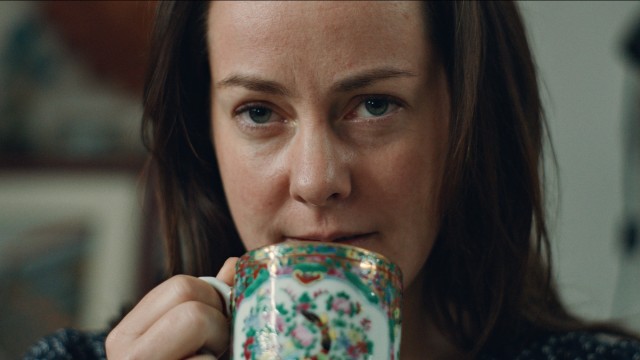
Jena Malone stars in the titular role of Sylvia in Jessie Barr’s short
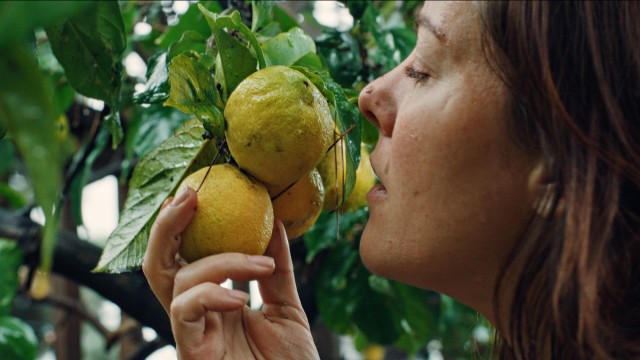
Sylvia follows a young hard-of-hearing woman living with her hypochondriac mother in a house ruled by constant care and strict routine. Her life has shrunk to a sense of obligation, but not without resistance. Sylvia’s desire leaks through in unexpected places – fleeing, erotic moments near the lemon tree that feel like brief escapes, as though her imagination is trying to break out of the body she’s been asked to inhabit.
When a stranger arrives, he doesn’t so much disrupt Sylvia’s world as collide with something already bubbling inside it. Barr tells the story without spoken dialogue, relying instead on sound design, subtitles, and a chaptered structure that echoes the rhythms of silent cinema. The result is a film that sits just on the right side of stylised, where the narrative is carried as much through texture and rhythm as it is through action.
“Her world is not the hearing world I was used to, so I became a student of the deaf and hard-of-hearing just as I became a student of silent films”
It would be easy to mistake the film’s silence for a purely aesthetic choice, but in reality it began as a creative constraint. Born out of the Modern Silent Shorts initiative – which also gave us Lindsay Callerhan’s I’m Really Scared I’m Dying TBH – a project that challenges filmmakers to work without recorded dialogue, what could easily have become a formal exercise instead became the guiding principle of Barr’s film.
“The restriction was daunting at first, but ultimately freeing,” the director shared with S/W. “What character would live in a silent world? What would feel truthful? Immediately, this character, this woman, Sylvia sprang to my mind. Her world is not the hearing world I was used to, so I became a student of the deaf and hard-of-hearing just as I became a student of silent films. I needed to immerse myself. I believe in studentship and the power of devotion in filmmaking.”
That process of immersion is evident throughout Sylvia. Rather than treating silence as an absence, Barr transforms it into a rich cinematic language, allowing gesture, sound design, rhythm and visual composition to communicate what words cannot. The result is a film whose formal restraint never feels limiting; instead, it draws us closer to Sylvia’s experience, inviting us to inhabit her world rather than simply observe it.
“I am by no means an expert. I am a visitor, but I hope those in the deaf and hard-of-hearing community feel seen in some way by the film.” – writer/director, Jessie Barr
The film’s greatest triumph, however, lies in its sound design. Silent cinema has always depended on music to communicate what spoken dialogue cannot, but Barr rejects the jaunty piano scores of the genre’s earliest classics in favour of something more intimate. The score in Sylvia pulses with breathy female vocals that hover somewhere between a sigh and a moan, creating the sensation that we’re not just hearing an accompanying music track to the visuals, but Sylvia herself. It feels as though every exhale is drifting directly out of her subconscious, turning the soundtrack into the lead character’s inner voice. The result is hypnotic and tantalising in all the right ways.
Barr’s nod to silent cinema continues in the film’s visual language. The story is divided with chapter titles and borrows another familiar trick from early cinema by speeding up moments of domestic routine. The effect could easily feel comic, but here it serves a different purpose: the frantic pace of Sylvia’s endless cycles of cleaning evokes Cinderella before the fairy godmother arrives, reducing her days to a blur of repetition that feels almost mechanical.
In contrast to that relentless rhythm, Barr lingers on moments where time seems to stretch: Sylvia savouring, sucking and licking the lemons on the tree, or masturbating in the bath as her thoughts drift towards her handsome house guest. The result is an intimate portrait of a woman whose richest life unfolds not in what she does, but in what she imagines.
Fairy tales have always promised that another life is possible. Sylvia makes no such promises. Its magic feels far more grounded, found not in spells or happily-ever-afters, but in the private acts of rebellion we perform when no one is looking. If every fairy tale begins with someone crossing a threshold, Barr reminds us that the hardest one to cross is often the one in our own minds.