
 Mariana Rekka
What are you willing to sacrifice to become yourself? Time? Money? Someone you love? All of the above?
Kylie Aoibheann’s The Dysphoria turns that question into a ’70s Satanic ritual and lets the answer crawl out in candle smoke, stained glass, and the haunting sound of cracking bones. In under 13-minutes, the film delivers an incisive, painful study of identity and the fight many trans people must wage to claim the place they deserve. Its bleakest revelation is that the “monster” is nothing more than the way one is treated simply for existing. The good news is that the film offers a deal, one that lets us set the price for inhabiting our own bodies. The bad news is that sometimes the price proves too high, leaving severing ties as the only recourse. In this case, that rupture is itself part of the sacrifice.
Aoibheann’s inspiration stems from the moment she woke after gender-affirming surgery and became fully aware of the personal cost: years of savings, invasive medical procedures, and people she had to remove from her life. This biographical friction gives the horror its power. In just a few lines, we grasp what the protagonist is feeling: the sense that her worth and identity are crumbling while her loved ones tell her she is “too sensitive.” I’ll always have a soft spot for witty writers who resolve a conflict by imbuing a single phrase with new meaning. I find it fascinating (in real life, too) how a tiny set of words can take on such profound significance in different contexts, how they can heal a heart or shatter it. If you’re anything like me, you’re going to love this film.
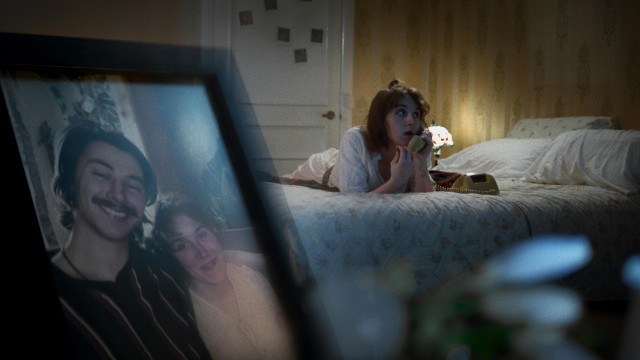
Eva Rees stars as a trans woman who performs a Satanic ritual hoping to get a vagina
The writing isn’t the only gem in The Dysphoria; the craft is formidable, too. Sharp FX’s practical body horror lands with tactility and menace, while the sound design, which I feel is the film’s secret weapon, shares the glory: every crack and squelch arrives with unnerving intimacy. The sounds haunt you, making you pay for the revenge you wanted to see. The whole film is steeped in a ’70s atmosphere, with both the aesthetics (antique wallpaper, denim bell-bottoms, canted angles) and the cinematography (split diopters, vintage lenses, hard lighting) placing a contemporary story firmly within the world of vintage supernatural horror.
The stained glass lends the main location an eerie, almost religious atmosphere, standing in stark contrast to the gore-caked bodies moving through it. Sacred and profane share the same frame, and the tension between them feels deliberate. As for the cast, the entire ensemble is memorable. Eva Rees, however, plays the protagonist with furious determination, fiercely conveying her anger and her conviction that she knows what she’s worth and is ready to claim it, whatever the cost. The urge for revenge in the climax lands hard because that cost has been made so visceral.
In the context of our recent horror programming, The Dysphoria stands out for the way it fuses old-school scares with a modern, deeply specific crisis. The film trusts viewers to keep up with its protagonist: her pain, her betrayal, and her bargain. The terror lies in the price demanded of her, and in the recognition that wanting to be yourself should never require a demon’s contract. But if a sacrifice is required, we will make it, whatever it takes.