 Serafima Serafimova
I’ve lost count of the number of times I’ve stayed in a situation I wanted to leave because leaving felt somehow ruder than enduring it. In my late teens and early twenties, this happened most often around sexual encounters: moments when my body was saying one thing and my mouth was saying something else, or nothing at all. I was raised to be polite, conditioned to understand that men were Very Sexual Creatures who simply couldn’t help themselves, and cursed with being a hardcore people-pleaser. So I usually smiled, stalled and occasionally went along with things I didn’t actually want, then spent days trying to work out what, exactly, had happened. Nothing terrible, really. Maybe? Just the sour aftertaste of having abandoned yourself to spare someone else an awkward moment.
It’s precisely that murky, difficult-to-name territory that Juliette Strangio explores in Learning to Eat Cake. Moving between the night itself and Tweety’s later retelling of it to friends, Strangio creates two versions of the same experience that sit uneasily alongside one another: the funny story you tell afterwards and the far less funny reality of how it actually felt. The 15-minute drama is a smart, sharply written examination of the grey areas around sex and consent, but what makes it really sting is how familiar it feels. There’s something deeply uncomfortable about watching an experience get turned into a punchline before the person telling it has quite worked out whether she found it funny. For anyone who’s been there, it comes with the unpleasant jolt of déjà vu.
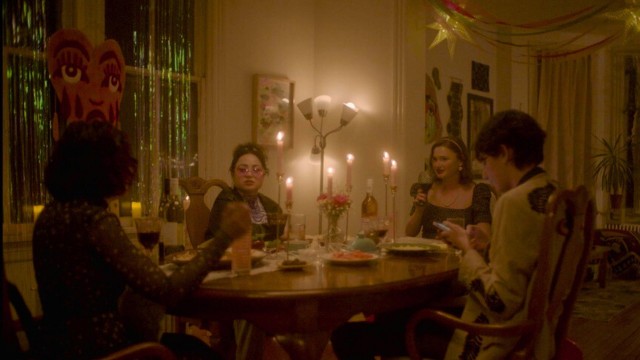
Tweety (Molly Ledbetter) – 2nd right – gathers with her friends for a birthday dinner
Tweety (Molly Ledbetter) has the sort of date that, on paper, should be a good one. She’s reconnected with Julian (Hayden Burke), a cute guy from high school, the chemistry is there and, for a while, he’s every bit as sweet and goofy as she remembers. But back at his apartment, something starts to shift. A kiss she happily agrees to becomes unexpectedly forceful, and Julian’s playful affection gradually turns into relentless sexual persistence, leaving Tweety in a situation that becomes increasingly difficult to navigate. By the time she recounts the evening over a birthday dinner with friends, however, the details have been diluted and served up as a funny anecdote.
When we asked Strangio about the inspiration behind the film, she shared that it came out of what she describes as “the gray space between weird sex and coercion.”
“I’ve lost count of how many times I’ve heard cool, bright women tell stories about those kinds of nights, but framed them as comedy, because if you don’t laugh about it you have to admit that maybe something you wanted to feel fun, actually felt terrible. There’s something really confusing and difficult about encounters that aren’t criminal but still feel violating – and you’re left wondering how to even define the experience.
“Most women have experiences like this, so hearing those questions from them was unexpected”
In my early twenties, I remember listening to a story much like the one in our film. What stuck with me wasn’t the uncomfortable details of the story, but the reaction. A handful of women older than me kept asking things like, ‘Why didn’t she just leave?’ or ‘Why didn’t she say no?’ I remember feeling genuinely bamboozled – most women have experiences like this, so hearing those questions from them was unexpected. As we talked, I reflected on uneasy moments where I was in a situation I wanted to leave. How responsible was I for my own discomfort? Why did I stay? The guys had always been so sweet, so why did it feel so hard in the moment? It felt hard to articulate.”
And that’s the twisted trick of Learning to Eat Cake: Julian really is sweet. Or at least, he can be. He makes Tweety laugh, asks permission before he kisses her and, at one point, even tells her that he wouldn’t want her to do anything she doesn’t want to do. Great. Lovely. Except he does. That contradiction is where the film really gets under your skin. Julian isn’t some creepy perv waiting for Tweety to drop her guard; he’s a guy who seems to genuinely believe he’s behaving well, while repeatedly bulldozing past every sign that the woman in front of him is no longer enjoying herself. Tweety says no, changes the subject, pulls away, tries to slow things down. He notices just enough to retreat, but never enough to actually stop. And suddenly that apparently simple question – why didn’t she just leave? – starts to feel much less simple.
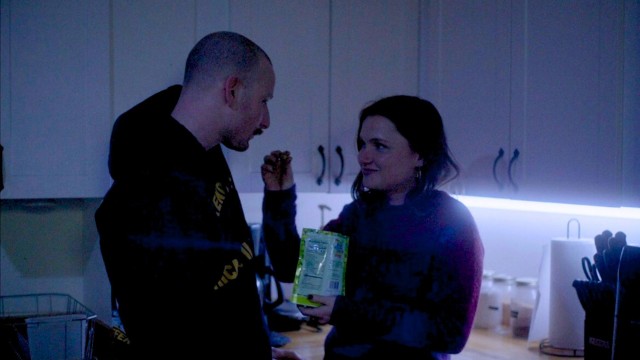
When the date moves to Julian’s apartment, it quickly begins to take on a different feel.
Because leaving isn’t always one big decision. Sometimes it’s a series of tiny surrenders. The cake scene gets at that perfectly. Tweety is diabetic, so when Julian offers her a bite, she says no. He asks again. And again. And again. Eventually, she eats the fucking cake. Not because she wants it, but because at some point it becomes easier to put the thing in your mouth than keep explaining why you don’t want it there. It’s funny, until it really isn’t. The cake is the film’s whole idea in a single bite: something that should bring you pleasure, but ends up causing you harm.
And then comes the next surrender: deciding what to call it. Strangio keeps cutting between what happened and the version Tweety later serves up to her friends, and the gap between the two grows wider. Because how do you explain feeling threatened when there was no single threat you can neatly point to? No violence. No screaming. No one moment that gives you permission to say: there, that was the bad bit. Tell the story seriously and you risk the inevitable questions – why did you stay? Why did you do that? – so sometimes it’s easier to make everyone laugh instead. Maybe if they laugh, you can laugh too. And if you tell it enough times as a funny story, eventually you’ll believe it was one.
Strangio knows that sometimes, the hardest thing to swallow isn’t what happened, but admitting that it counted. And if you’ve ever laughed at something before you were ready to admit it hurt, Learning to Eat Cake will hit a nerve.