
 Jason Sondhi
Iam not especially good at the elevator-pitch school of film description—the “X crossed with Y” formulation—but fortunately a Letterboxd user has done the work for me: Suo Jiang, the latest short from Taiwanese filmmaker Lin Chien Yu, is like Wong Kar-wai crossed with Haruki Murakami—a description I find unusually tidy for this gorgeous, but slightly enigmatic film that utilizes its film craft to invoke feelings more than to deliver story.
The short’s locksmith protagonist is a quiet, taciturn man capable of entering almost anywhere, yet unwilling to find his way back into his own life. In the midst of a divorce, he sleeps in his cluttered shop, which contrasts pointedly with the immaculate, high-end dwellings of his customers. An orbit of lonely individuals share his screen: a guardsman for the neighborhood buzzes around delivering gossip and unrequested advice, a middle-aged woman in an unhappy marriage hovers, seeking to perform acts of kindness and garner the locksmith’s attention. He becomes fixated on a hostess. And, increasingly, his movements through Taipei take on the strange, suspended quality of a dream whose meaning remains just beyond reach.
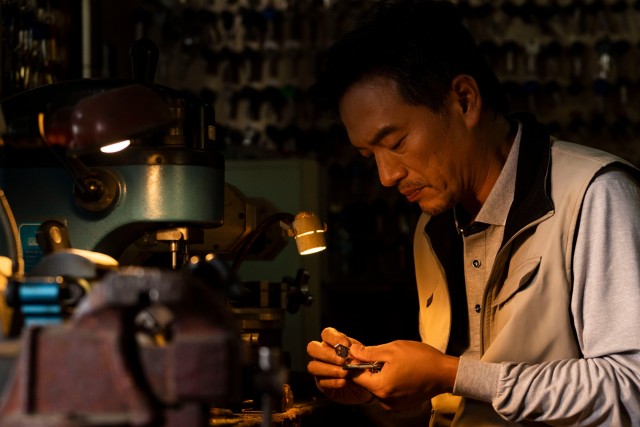
The locksmith, absorbed in his workshop
Lin found the germ of the character close to home. “The inspiration came from a real locksmith shop near my home—cluttered with objects that had nothing to do with locks, yet the locksmith moved through that space like it was exactly where he belonged,” she explains. “That contradiction sparked my imagination about who he used to be, and what he was quietly holding onto.”
There’s certainly some Wong in the nocturnal urban romanticism of Suo Jiang: lonely people circling one another, feelings displaced into gestures and objects, interiors glowing against the darkness outside. But it’s the Murakami half that gets closer to the film’s peculiar wavelength and provides its rather meager “high concept.” The recognizable world that Lin establishes is invaded by something quietly inexplicable, as a mysterious blue door shows up off the beaten path and becomes an object of obsession for our lonely locksmith. This sounds like a major development that reorders the plot and world, and its metaphorical centrality to the film is undeniable. Yet, fair warning: the film is less interested in solving the mystery than in the psychological gravity it exerts.
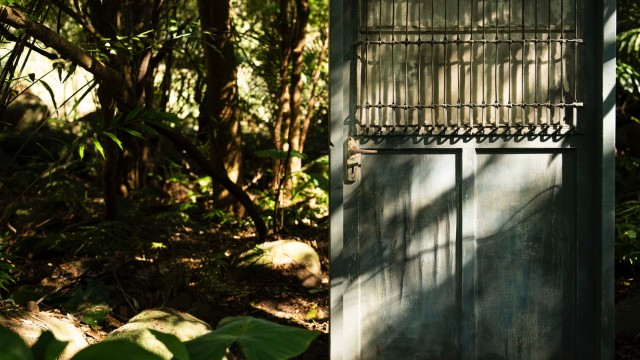
The unexplained blue door
That approach could easily become frustrating. Suo Jiang is not a propulsive film. Its characters are withdrawn and emotionally repressed, and Lin withholds many conventional satisfactions. Yet I never found myself impatient with it. Quite the opposite—here is something deeply reassuring about the command with which Lin tells this story. First, it is sumptuous—her background in fashion design before graduating from The London Film School seems especially legible in the intricate, lived-in production design, but the photography is excellent, and the film exerts a mood and pace that are easy to slip into. Even when we don’t quite know where we are going, there’s a palpable sense that the filmmaker does.
That assurance is particularly notable because Lin describes Suo Jiang as a departure. Known for more experimental, non-narrative work, she wanted this film to be “more accessible,” using a comparatively simple story to capture “the confusion and disorientation of losing a sense of home.” Accessibility is relative here, and I initially tripped myself up by treating the locksmith too conventionally as the protagonist—trying to determine how the hostess, or the neighborhood guardsman who is granted the film’s concluding shot, fit into his story. It’s more fruitful to see Suo Jiang as something closer to an ensemble portrait of loneliness, I think. The locksmith remains the gravitational center, but these supporting characters around him are not merely facets of his narrative or functional pieces of plot, but something like open doors to other stories, waiting to be told.
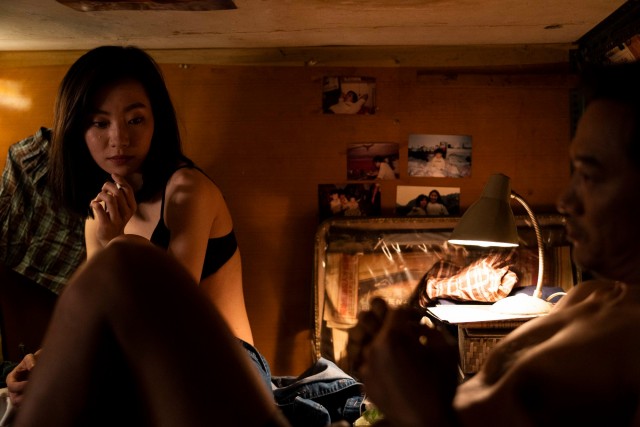
Characters circle the plot of the film without fully imprinting on it, including a hostess character
That also makes the film’s metaphorical vocabulary—keys, doors, and locks—feel somewhat less schematic. Lin has said that she originally didn’t want her locksmith to open the mysterious blue door at all. Within his professional code, a door should never be forced; when this supremely capable man finally violates that rule, brute force becomes an admission of impotence. “In that moment,” Lin explains, “I embedded his weakness and inner conflict.” The question isn’t really whether this man possesses the key to his loneliness, but what happens when the skills and rules by which he has organized his life cease to work.
Suo Jiang is not an obvious crowd-pleaser, and its symbolism is not particularly subtle. But the ease with which I let Lin carry me through its 16-min runtime imprinted upon me and carries great weight. The film’s imperfections feel less consequential than the confidence surrounding them. Lin has an unusual command of image, atmosphere, performance, and space, and the fearlessness to let these aspects of craft serve as the primary support for her story. This film, her second major short, won Sundance Asia in 2024 before screening at the main festival in 2025. With her debut feature Honey Milk heading toward production this year, Suo Jiang feels like a calling card: evidence of a young filmmaker whose sensibility is already fully formed and who seems ready for a much larger stage.