
 Rob Munday
Created from a desire to see the kind of contemporary queer representation he felt was missing from the screen, Jasper Caverly’s immersive short film Pleasure takes its audience deep into Australian Eshay subculture on a night of graffiti, blood and relentless banter. Brimming with tension, to the point where you can almost hear the air crackle between its characters, Caverly’s short balances a rough, abrasive exterior with a surprisingly tender and moving core. The result is a film of fascinating contradictions, where masculinity, intimacy and vulnerability continually collide.
With Caverly a firm believer that a “director is only as good as their actors”, much of the film’s success rests with Stacy Clausen and Liam Mollica, whose performances as two young ‘adlays’ hanging out and pushing boundaries provide its emotional centre. Their relationship is driven by banter, bravado and the kind of hyper-masculinity that makes vulnerability difficult, yet their exchanges never feel performative. Instead, there is an effortless rhythm to their back-and-forth, suggesting a friendship with years of history behind it. This authenticity makes the moments when that rough exterior begins to crack all the more affecting, particularly when the pair are afforded a rare opportunity for intimacy and openness.
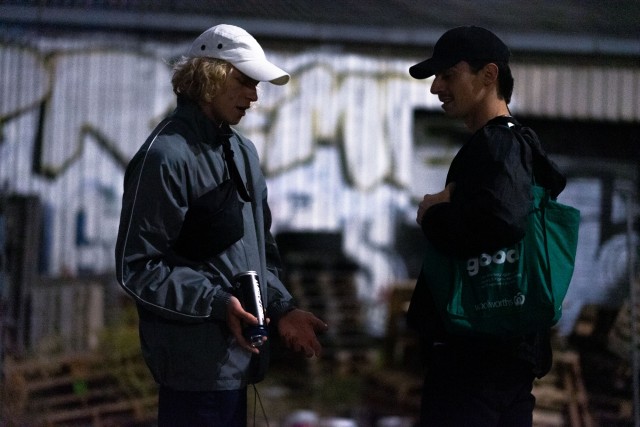
Stacy Clausen (L) and Liam Mollica on the set of Jasper Caverly’s Pleasure.
Working with cinematographer Nyssa Mitchell, Caverly reinforces this sense of closeness through the film’s visual language. Shot handheld on a 50mm lens, Pleasure rarely allows us to feel removed from its protagonists, keeping the camera physically and emotionally close to the action. Caverly has described his desire for the audience to “ride in the front seat” and that philosophy is evident throughout. At times, we feel almost like a third wheel on this night out: permanently positioned over the shoulders of these two young men, close enough to experience their energy but never so intrusive that we disrupt their bond.
Caverly gives a lot of thought to the perspective of his audience and it’s clear from Pleasure that this consideration is not only one of the film’s greatest strengths, but also one of the filmmaker’s. Rather than feeling the need to overly explaining his characters, or their actions, he instead immerses us in their world and trusts us to find our own way through it. That approach not only helps the film land its emotional impact, but gives it an identity that feels distinct, memorable and difficult to shake.
And that, ultimately, is exactly what we look for at Short of the Week. Pleasure isn’t simply a film that offers representation; it demonstrates how a filmmaker can use performance, perspective and craft to make that representation feel lived-in and authentic. More importantly, it feels like the introduction of a filmmaker with something genuinely interesting to say – and a distinctive way of saying it.