
 Rob Munday
Airports are places of contradiction. For some, they mark the beginning of a new adventure or the long-awaited return of a loved one. For others, they are spaces defined by anxiety and painful farewells. For Iranian immigrant Tara Aghdashloo, these transitional environments carry a particularly personal significance, embodying both “the promise of a better future” and “the pain of those left behind.” It is perhaps no surprise, then, that she chose to set her impressive short film, Empty Your Pockets, within one of these liminal spaces, using the airport as the backdrop for an absurd yet sharply observed exploration of bureaucracy, power, and systemic corruption.
While Empty Your Pockets essentially follows a day in the life of customs officer Hassan, it is ultimately concerned with much larger questions. Writer/director Aghdashloo rather poetically describes the film as being about “how a corrupt society – or an infested jungle – affects everything within its ecosystem” and that idea permeates every aspect of the narrative. There is a famous quote, often attributed to W. Edwards Deming, that claims “a bad system will beat a good person every time,” and unfortunately that feels like the film’s central thesis here. Hassan tries to act with integrity, prioritising the wellbeing of passengers over bureaucracy and self-interest, but he gradually finds himself overwhelmed by the very system he is attempting to resist.
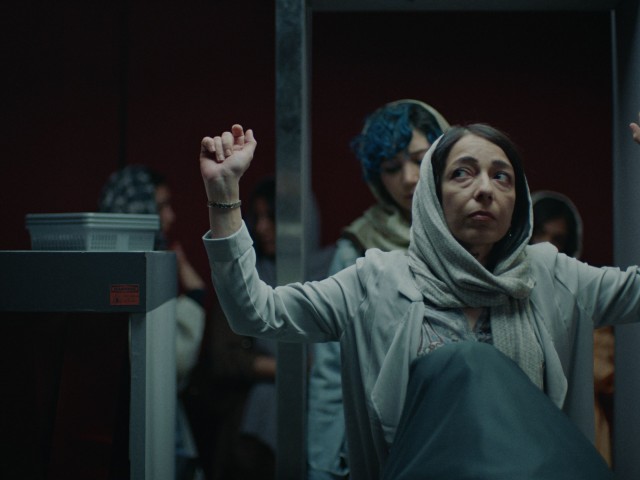
“I spent a long time searching for cast, and was very adamant about authenticity of representation in the film” – Aghdashloo discussing the prodcution.
This theme is reinforced through the film’s recurring references to ants, particularly leafcutter ants, which are known for their mutualistic relationship with fungus – the ants cultivate and protect the organism, and in return use it to feed their colony. In Empty Your Pockets, this ecological relationship becomes a ripe metaphor for institutional corruption, where individuals become locked into a system that both sustains and exploits them. For Hassan, the question is whether he can resist that system, or is he simply another ant trapped within a codependent structure that is impossible to escape?
However, Aghdashloo’s film is not solely interested in criticising the “exceptional circumstances and horrible systems” governing her homeland. It also seeks to challenge common misconceptions about Iran by highlighting what she describes as “the diversity, the energy and the humanity” of its people. Alongside its critique of corruption, the film works to reveal the everyday lives that exist beneath political headlines, reminding audiences that within Iranian society “there is so much tender beauty, and relatable universality.”