
 Chelsea Lupkin
The horror genre has historically pushed the boundaries of filmmaking, and Tomas Palombi’s Au Prix de la Chair (The Cost of Flesh) is an incredible example of that tradition. Shot entirely through the reflection in a teenage girl’s eye, a horrific story comes into focus: a desperate attempt to cure a paralyzed sibling through supernatural means. What would be sacrilegious to most of us becomes, in Palombi’s hands, a horrific act of love, explored with a keen understanding of both perspective and the genre itself. The film begs the question: How far would you be willing to go for your loved ones and when is a line crossed? Palombi’s execution of craft, cinematography, and story delivery are visionary… literally.
“I wanted the audience to feel trapped with a character who can no longer physically act”
With a runtime of almost ten minutes, you might expect to grow bored or frustrated that Palombi never changes frame, but it’s precisely this choice – a risky one at that – that keeps it so compelling. All we ever see is the reflection of the scene in someone’s eye, while overhearing fragments of conversation that slowly clue us into what is actually about to happen. Because it is a reflection, every blink or subtle shift in the young girl’s gaze reveals a little more – or obscures it. Palombi believed this would be a powerful cinematic device for horror – and he was right.
“It allowed me to subtly distort reality, turn off-screen space into a source of tension, and draw the audience into an intimate and unsettling point of view,” Palombi tells Short of the Week. “By limiting the film to that perspective, I wanted the audience to feel trapped with a character who can no longer physically act, and to share something of her vulnerability and helplessness.” And let’s not forget her terror. Frankly, I’ve seen more riveting acting from Nayla Berrada’s eye performance than I’ve seen from many actors with their entire bodies on screen. She deserves an Oscar. By the time the story escalates – and shit really escalates, folks – I was truly scared for her.
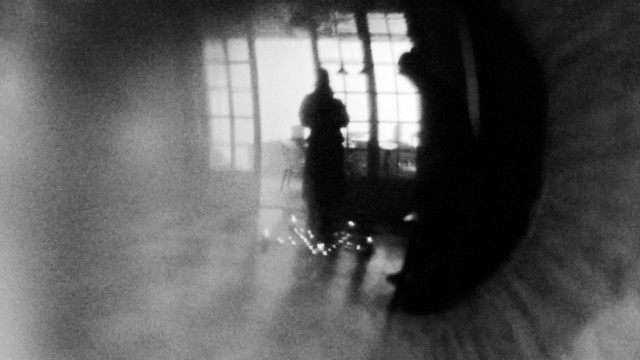
“It allowed me to subtly distort reality, turn off-screen space into a source of tension, and draw the audience into an intimate and unsettling point of view” – Palombi on his decision to shoot the film in the reflection of an eye.
Having first been struck by the idea while filming a music video, Palombi’s cinematography chops helped him troubleshoot all of the tricky technical hurdles of his ambitious vision. Despite the complexity of the concept, he executed the entire shoot without relying on digital effects. “The film was built around the real reflection of the eye, which allowed the images, the actors’ performances, and the horror to feel more organic and tangible despite the technical challenge and the length of the continuous take.” So all of those spooky shadows the siblings don’t notice or that creature prowling in and out of the room had to be staged through blocking. Coupled with spooky sound design by Arthaud Versaveaud, The Cost of Flesh is both an impressive one-er and a chilling work of fiction.
Inspired to tell a story about illness, dependence on others, and a family’s willingness to do anything – even summon an evil monster – The Cost of Flesh reveals an interesting takeaway: you can’t move forward without giving something of yourself to the devil. In other words, love can make you do terrible things, whatever the consequences.
Premiering at Tribeca Film Festival, The Cost of Flesh screened at Flickers’ Rhode Island International Film Festival, Leeds International Film Festival, Fantasia International Film Festival, and Beyond Fest. And for a film that roughly took only ten people to make, all we can say is: hat’s off to you!