
 Rob Munday
A large part of the motivation behind Short of the Week lies in the discovery of exciting new talent and the sharing of new perspectives and stories – both of which were a driving force behind the inception of our Pride Shorts competition. While these values were communicated to the competitions jury, Charlie Tidmas and Carlen May-Mann – two alums who know first-hand what a S/W pick represents – ultimately we were placing this curatorial task in the hands of individuals outside of our regular selection team. Given that curation is at the very heart of what defines our platform, I have to admit that caused a little anxiety. Thankfully, I needn’t have worried, because (of course) they absolutely nailed it.
Between Us, the intimate short from Cailleah Scott-Grimes and the first-ever winner of our Pride Shorts competition, embodies everything we hoped to discover through this initiative. Its tender portrait of a queer-trans couple navigating relationship difficulties against the backdrop of rural Japan offers a perspective that feels unparalleled and highly specific, yet universally resonant. The film approaches its themes of identity and belonging with remarkable sensitivity, never sacrificing emotional honesty for easy answers.
Perhaps most excitingly, Between Us marks Scott-Grimes’ first narrative short, making it feel not only like a deserving winner, but also like the introduction of an exciting new voice in filmmaking. If this film is any indication of what’s to come, it’s certainly a debut that demands attention.
“My goal was to peel back the complex, beautiful, and painful ways in which belonging looks different for each of us”
Between Us opens in an unassuming but economical manner. A simple scene of a couple sharing a bed introduces the characters in quiet fashion, advances are spurned without a word exchanged and we already sense a distance between these two people. The morning after, we witness Kei injecting testosterone in their thigh, before a disagreement with their partner, Erin, about shaving for a job interview reveals deeper anxieties about being “outed” within their rural Japanese community.
“I wanted to make a film that proposed a counter-narrative to the idea that we can only live authentically as genderqueer people when we leave our small-town roots behind,” Scott-Grimes explains when discussing how Between Us was informed by their own experiences of “living in rural Northern Japan.” By focusing on the “insular world of a cross-cultural couple,” the filmmaker sought to “peel back the complex, beautiful, and painful ways in which belonging looks different for each of us.” That ambition is felt throughout the film, which resists simplifying either its characters or their circumstances.
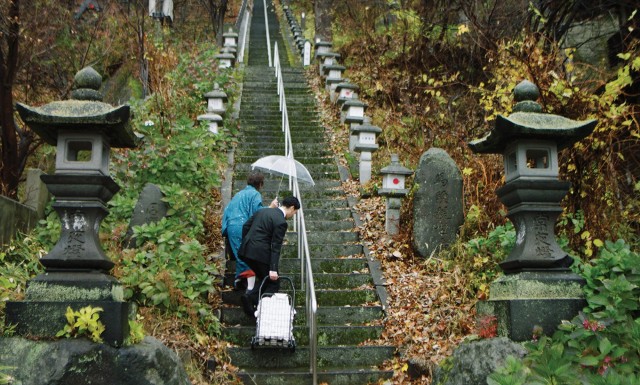
“We shot the film in the 300-person hot spring village of Zao Onsen, near Yamagata City, where I used to live” – Scott-Grimes revealing the logistics behind the production
With both our Pride Shorts jury and Scott-Grimes themselves describing Between Us as “tender,” it’s difficult to imagine a more fitting word for the film. That tenderness is central to its success. While questions of gender identity remain contentious topics for some, here they are approached with such care, empathy, and emotional honesty that the film never feels interested in confrontation. Instead, it invites understanding. Moments that might have been treated as dramatic flashpoints in another film – the testosterone injection or the vulnerability of undressing in a public space – are handled with remarkable restraint. By presenting these experiences with a light touch and without sensationalism, Between Us quietly challenges the stigma that can surround them, encouraging viewers to see them not as points of difference, but as ordinary parts of a person’s life.
Talking of challenges, while Between Us unfolds with a calm, natural rhythm on screen, its journey to completion was anything but straightforward. Producing the film independently and without an established filmmaking network in Japan, Scott-Grimes faced numerous logistical obstacles. There wasn’t even a completed script until just weeks before production began. However, the director’s fluency in Japanese and background in documentary filmmaking proved invaluable. Drawing on those experiences to “mirror some of those processes” in their research, they also relied on personal connections within “queer and trans networks” to help bring the project to life.
“An adventurous experiment in working across languages, cultures, identities and generations”
With Scott-Grimes based in Toronto during pre-production, much of the prep involved “2am phone calls from Toronto to Tokyo,” while the cast itself was assembled through a “two-way interview process” that ultimately led to the selection of first-time actors. Those performances are central to the film’s success, making Between Us a compelling example of how unconventional casting and long-distance collaboration can yield remarkable results. Shot in the hot spring village of Zao Onsen, near Yamagata, the production brought together a diverse group of participants. As Scott-Grimes explains, it became “a collaborative effort between trans talent, film professionals, office workers, students, and seniors,” with “the whole thing feeling like an adventurous experiment in working across languages, cultures, identities and generations.”
Despite these hurdles, Between Us stands as an important achievement, both for Scott-Grimes as an emerging filmmaker and for audiences seeking more nuanced queer representation on screen. The film’s warmth, specificity and honesty demonstrate the power of personal storytelling, while its production serves as a reminder that independent cinema is often built through community and collaboration. Although we are far from the first to recognise the talent on display here – the short had an impressive festival run, playing at Image+Nation and others – we couldn’t be happier to have Between Us as the winner of our Pride Shorts competition. It is exactly the kind of film we hoped this initiative would help us discover.