
 Rob Munday
Based on the short story of the same name by Russian novelist Fyodor Sologub, Un Petit Homme (A Tiny Man) from filmmakers Aude David and Mikaël Gaudin thrusts viewers into the uneasy power dynamics of a marriage, as a husband takes increasingly drastic action to confront his feelings of inferiority. Rendered through striking charcoal animation, this 10-minute short avoids easy comedic clichés, instead unfolding as a darkly allegorical meditation on gender roles, masculinity, and control.
A Tiny Man begins in a subdued and atmospheric fashion. Birds drift across the sky as the opening titles appear among their movements. The first glimpse we get of one of the film’s central figures – the wife – is of her feet and legs: sturdy and assured as they step toward the viewer. When her face is finally revealed, it is framed from below, the low angle emphasising her imposing physical presence.
The introduction of her husband is equally precise and revealing. He first appears through shadow, his smaller silhouette trailing behind hers, head lowered. Nothing is spoken and there is no direct interaction between the pair, yet the film immediately establishes both the nature of their relationship and the themes underpinning the narrative. If ‘short man syndrome’ truly exists, then David and Gaudin perfectly translate it to the screen through their exquisite black-and-white animation.
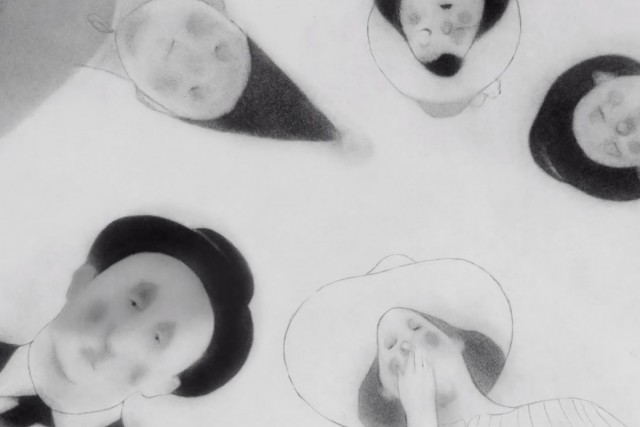
The husband in A Tiny Man is preoccupied with how others see him and his relationship
As the narrative unfolds, we watch the husband attempt to control the literal proportions of his wife, only for his efforts to unravel and the perceived distance between them to grow ever larger. While the film operates in an abstract and surreal world, it also manages to remain rooted to real-life, through recognisable emotional anxieties. Although Sologub’s original story is more than a century old, David and Gaudin adapt it in a manner that feels simultaneously classical – through its handcrafted visual style – and timeless through its absence of fixed historical detail.
For a film so preoccupied with proportion and scale, A Tiny Man serves as a reminder of the remarkable impact a ten-minute short can achieve. Without David and Gaudin’s adaptation, I likely would never have encountered Sologub’s original tale, and that in itself speaks to one of the enduring strengths of short film: its ability to revive, reinterpret, and reintroduce stories across generations and mediums.