
 Jason Sondhi
In a piece I wrote last year, I noted that AI filmmaking has developed a slightly obnoxious tendency toward navel-gazing—an impulse to engage philosophically with the means of its own creation. Paul Trillo’s The Most Perfect Perfect Person, created in collaboration with the American music star Poppy, leans directly into that instinct—it’s a film that is very much about AI, made with AI, and conscious of both. What distinguishes it is not that it avoids the trap, but that it transcends it, finding rare alignment between subject, method, and meaning that makes the self-reflexivity feel earned.
Set in a near-present that feels only mildly exaggerated, the film follows Poppy as she relinquishes her public-facing self to an AI duplicate trained on her entire creative output. The clone feeds her responses in real time—during interviews with the press, interactions with her fans, and even on phone calls with friends—until the distinction between author and artifact collapses. It’s a familiar enough premise on paper, but Trillo locates it in the particularly fertile arena of pop music, where identity has always been both product and battleground, and the excitement of creative innovation is balanced by the specter of commodification.
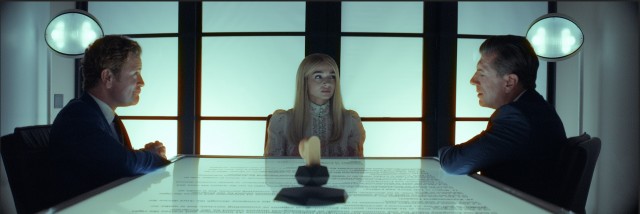
Poppy, with her management team, being pitched her chatbot duplicate
The stakes are articulated most clearly in Trillo’s own framing of the project. “AI threatens to take away more than just jobs; it threatens to take away an artist’s voice. We risk a real homogeneity of culture. Bots making content for bots. Originality is at stake.” It’s a strikingly critical stance from a filmmaker who has, in recent years, become one of AI filmmaking’s most visible proponents. For a sizable portion of the audience—particularly those wary of AI’s encroachment into creative fields—these quotes may seem rich.
But, Trillo is, arguably, sui generis among AI influencers in his traditional production chops and the strength of his filmography: five Short of the Week selections since 2010, over a dozen Vimeo Staff Picks, and a deserved reputation as one of the great technical innovators of his generation. His use of AI tends to be deeply conceptual and hybrid in execution, emphasizing its incorporation into professional workflows—something he’s actively helping to build via his role at the AI studio, Asteria. In this short, AI is neither gimmick nor replacement—it’s a tool, deployed with intention, in service of a cohesive vision. Trillo’s stated fears land not as rejection, but as something closer to self-interrogation.
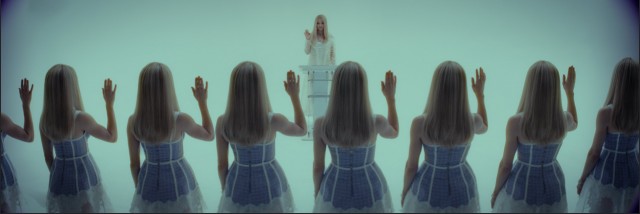
Trillo visualizes an LLM’s inner workings—Poppys spawning and collapsing in succession.
The deployment of AI not only as a subject, but as a method, helps provide the film with an interesting charge. Trillo’s AI usage oscillates between the overt—glitchy morphs, proliferating selves—and the invisible, where the tech functions more like traditional VFX. The result is a formal instability that mirrors the film’s thematic concerns: you’re never quite sure what you’re looking at, or how it was made, and that uncertainty becomes the point.
The team leans into this ambiguity in its marketing, calling the film “based on true events,” with Poppy playing a version of herself and her AI counterpart’s dialogue generated by a Poppy chatbot that the artist trained for a previous performance art piece. There’s something conceptually intriguing in this—an ontological slipperiness that gestures toward something unsettlingly real. And yet, the film stops short of fully inhabiting that liminality. Its corporate antagonists are too arch, its visual design too stylized, Poppy’s performance too detached, to sustain the illusion. Rather than playing with Documentary styles, The Most Perfect Perfect Person lands closer to a sleek episode of Black Mirror, which, to be clear, is not a knock.
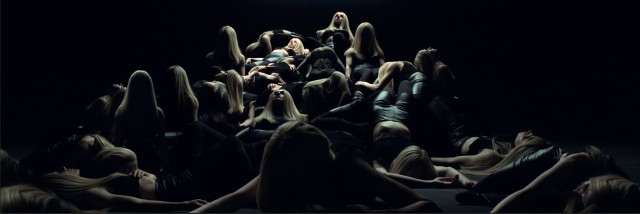
Poppys tested and discarded in the span of a thought
Perhaps though, that slickness and clarity of tone allow the film’s ideas to resonate more cleanly. Trillo is less interested in convincing us that this is happening than in showing how easily it could. Notably, the project began production in 2024, before premiering at LA’s celebrated Flux Screening Series, yet its central conceit—AI replicas of artists, trained on their likeness and deployed at scale—has already begun to materialize. What might have read as speculative even a year ago now feels like a near-term inevitability.
Which ultimately circles back to the film’s central anxiety. The danger isn’t that AI will replace artists outright, but that it will erode the friction that makes their voices distinct. In outsourcing expression—whether to algorithms, platforms, or audience expectation—we risk arriving at a culture of perfect fluency and zero authorship. Bots making content for bots, as Trillo puts it.
The Most Perfect Perfect Person doesn’t resolve that tension, but it renders it with uncommon precision—and in doing so, makes the loss of voice feel not speculative, but already underway.