
 Rob Munday
Filmmakers have adopted a wide range of approaches – from cute animation to hard-hitting documentary – to engage with environmental concerns in their work. For Hannah Schierbeek, however, the intention behind her short film, A Black Hole Near Kent County, was to create what she describes as an “environmental mystery.” Drawing on her own experiences of pollution in Midwestern America, Schierbeek’s film functions both as a deeply personal tribute to her grandmother, who died from a rare form of blood cancer and as a haunting exploration of the effects of industrialisation.
A Black Hole Near Kent Country begins in striking fashion – a landscape literally ablaze – before transitioning into a more contemplative rhythm as we follow its protagonist, Julie, navigating her hometown in search of answers to an unexplained illness. As both writer and director, Schierbeek asks for a degree of patience from her audience, revealing the narrative details gradually, until they build to an emotionally-charged and unforgettable conclusion.
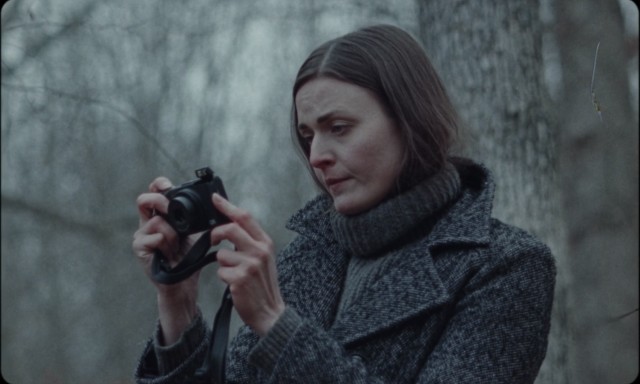
Mariea Luisa Macavei stars as a journalist in A Black Hole Near Kent County
It is within the film’s editing and carefully calibrated pacing that its impact most fully emerges. The deliberate unfolding of the narrative not only allows viewers to become immersed in the stark, wintry landscapes and Julie’s interior world, but also creates space for reflection. While the setting and situation here are highly specific, the film’s central themes – pollution, isolation, and justice – resonate more broadly. With Schierbeek ensuring that her viewers are given both the time and the space to consider their own relationship to these concerns.
The impact of A Black Hole Near Kent County is further heightened by the observational quality of its cinematography, which lends the film a grounded, almost tactile authenticity. Schierbeek notes that the decision to shoot on 16mm – her first time working with the format – was motivated by a desire to “capture the texture and depth of colour” characteristic of Midwestern winters. At the same time, the choice imposed a certain discipline to the production, helping to keep it within budget.
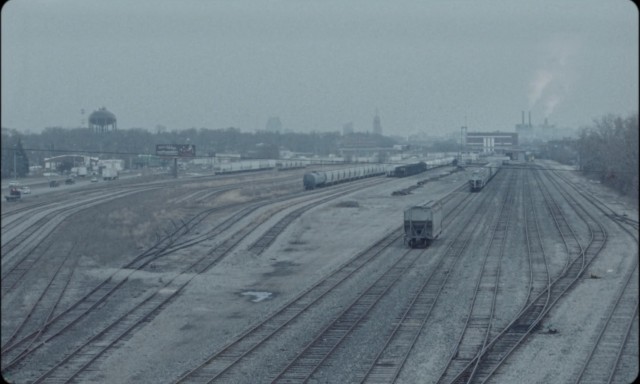
Schierbeek reveals they used the framing “in a way that made our world feel isolating and even a bit frightening at times.”
“Most of our scenes were limited to one to three shots, and we shot very few takes in order to bring costs down,” Schierbeek explains. She adds that the film was shot using predominantly natural light, with camera movement deliberately restricted through the consistent use of a tripod. This approach not only reinforces the film’s observational tone, but also frames the environment in a way that renders it isolating and, at times, subtly unsettling.
Following a festival run that included screenings at Clermont-Ferrand International Short Film Festival and Ouray International Film Festival, we are pleased to host the online premiere of A Black Hole Near Kent County on Short of the Week.
Since completing the film, Schierbeek has continued to build momentum: her follow-up directorial work, Radiant Frost, is currently on the festival circuit, having already screened at Sundance Film Festival in 2026. Her work as a producer has also drawn attention, with Don Josephus Raphael Eblahan’s Vox Humana (a favourite of mine) appearing at both Clermont-Ferrand and Sundance in 2025.