
 Jason Sondhi
Where the Black Sand Burns is a beautiful short film. I use that adjective in a literal sense – shot amid the natural splendor of the volcanic Canary Islands, featuring unusually striking cinematography, and anchored by a luminous central couple, director Lore Loyens’ tale of young love practically assaults you with its beauty. And while that phrasing might condition you to expect a turn – beauty as a substitute for substance – there’s no such caveat here. Loyens’ film may trace a familiar narrative shape, but its sensitivity to emotional nuance emerges as an equal achievement to its more obvious visual appeal.
The film opens with the promise of something apocalyptic, as a volcano stirs to life on the edge of a small village. This event is not unusual to the community, nurtured in the shadow of the peak, but Mateo, who is rooted to the island, watches as Alejandra, his partner, begins to interpret the looming eruption as a final straw – an ultimatum to leave. What follows is less a narrative driven by the mechanics of disaster than one attuned to emotional drift, to the quiet, destabilizing realization that love and one’s direction in life don’t always align. The volcano, despite its narrative weight, recedes from the foreground as the film unfolds. You find yourself almost wishing for its presence to press in more insistently, but its absence is also its function, as it becomes atmosphere, a low, constant pressure shaping everything without needing to dominate it.
“It can feel healing to dissolve into something larger than yourself”
This tension between the monumental and the intimate, the external and the internal, is where Loyens’ film finds its footing. As she describes it, she was drawn to “how a place can mirror an emotional state… how it can feel healing to dissolve into something larger than yourself, yet also deeply unsettling to feel small within an overwhelming, all-powerful nature.” The volcanic landscape, thus, isn’t just a backdrop, but a kind of emotional register for the film. The push and pull between Mateo and Alejandra – between staying and leaving, attachment and autonomy – echoes the instability of the terrain itself.
What’s striking is how immersive that dynamic becomes. Loyens resists over-explanation, instead constructing what she calls a “sensory experience of young love – something overwhelming, physical, and unpredictable.” The result is a film that pulls you into its rhythms rather than spelling them out, allowing interior and exterior realities to blur. Emotions aren’t articulated so much as absorbed, felt through gesture, proximity, and the charged stillness between characters.
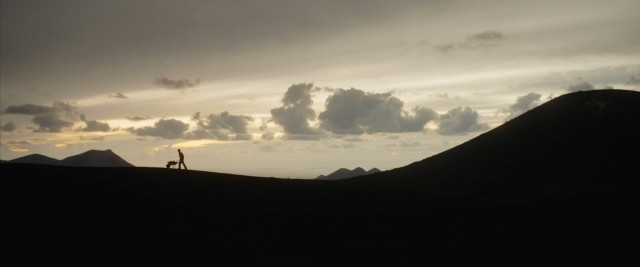
The landscape of the volcanic island provides the film’s “emotional register.”
A large part of that immediacy comes from the film’s production approach. Shot on location with a cast composed largely of non-actors discovered on the island, Where the Black Sand Burns carries an unforced authenticity that keeps it grounded even as its imagery tends toward the rapturous. Loyens and her team worked with “a small, flexible crew, allowing [them] to respond to the unpredictability of nature and fully integrate it into the film’s language,” and you can feel that openness in the direction of the performances, and a seeming willingness to follow moments rather than stage them.
This receptivity might be what most impresses me, and is a vital complement to the film’s themes and romantic visual sensibility. Loyens composes her images with a boldness and polish that is likely to result in her becoming a commercial directing star in her native Belgium – sun-drenched skin, sweeping vistas, bodies in silhouette against elemental forces, all feature prominently. But, throughout, she remains intuitively responsive to her performers, attuned to the fragile, often contradictory emotions that animate them. It’s a difficult balance to strike, and one she navigates with impressive precociousness.
It’s also not a one-off. With her follow-up, Between Day and Dawn, already making its way through the festival circuit, Loyens appears to be building a body of work that pairs visual ambition with emotional permeability – films that don’t just depict feeling, but allow you to sit inside it. Where the Black Sand Burns is an assured, evocative statement of intent for an exciting new artist. Consider me a fan.