
 Rob Munday
Within families, both tangible – heirlooms – and intangible – memories – inheritances are passed down across generations. In Ruth Hunduma’s powerful short film, The Medallion, these two forms of legacy converge as a piece of her mother’s jewellery, handed down to the filmmaker, becomes a catalyst for reflection on life in Ethiopia during a period marked by political violence and massacres.
The film opens in a poetic fashion: a voiceover lyrically describes the land of Ethiopia, accompanied by a montage of evocative imagery. This immersive exposition establishes the tone for a work that is at once deeply personal, historically unflinching and formally experimental. While The Medallion engages with questions of family and identity, it also offers a stark examination of the period of state violence in 1970s Ethiopia known as the Red Terror.
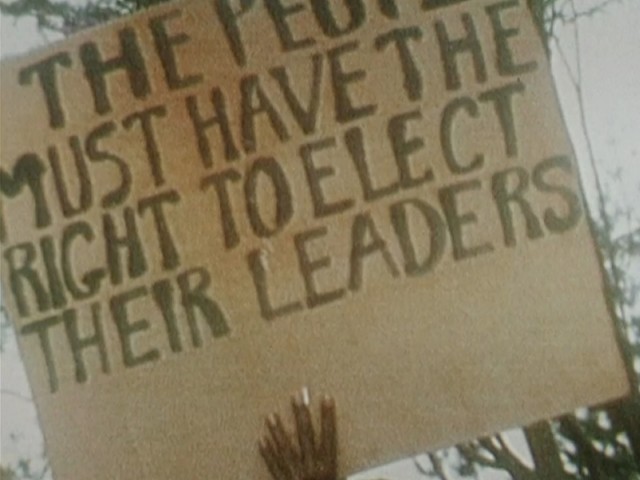
Archival footage is used effectively throughout The Medallion
Prior to watching The Medallion, my own awareness of this historical episode was non-existent. Hunduma has noted that this relative absence of knowledge in the West – alongside limited media attention surrounding the more recent Tigray War – formed a key motivation for the project. As she explained, in this interview on myDylarama: “The Red Terror genocide came and went, and remained relatively unknown in its aftermath, and I had a deep dread that the same would happen.”
As with many filmmakers who focus their work on conflict, Hunduma seeks to expose the human element behind these events. The use of archival footage in The Medallion provides important context, but it is the testimony of her mother, Tsehay, that proves most affecting. Her recollections of the violence she witnessed carry a weight that surpasses visual representation; though delivered with composure, the emotional resonance is unmistakable.
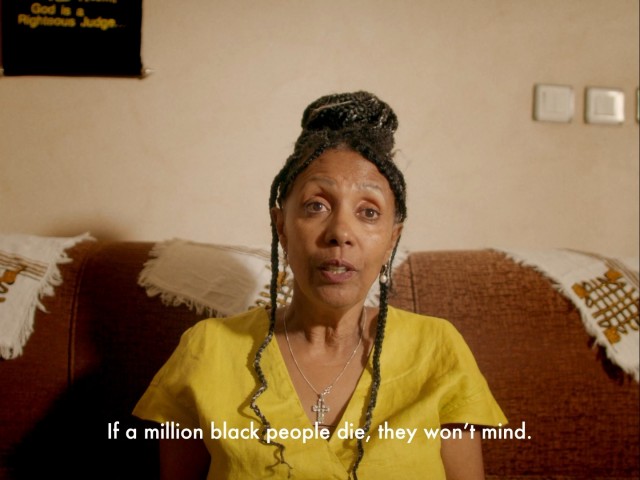
The closing statement of the filmmaker’s mother, Tsehay, leaves a reverberating impact.
Crucially, this sense of pain is not confined to the past but extends into the present, shaped by a perceived lack of global empathy toward ongoing conflicts. Her closing reflection – “If a million Black people die, they won’t mind. But if one white person dies? That’s what everyone wants to talk about” – underscoring this enduring imbalance.
In this respect, The Medallion also highlights the broader significance of the short film form. Beyond serving as a platform for emerging filmmakers, it can play a vital role in preserving and disseminating historical narratives that might otherwise remain largely unheard. Without this film, my own understanding of the Red Terror would likely have remained limited; the same may be true for thousands of the film’s other viewers.
While written records of the period certainly exist, Tsehay’s testimony offers an immediacy and emotional clarity that is difficult to replicate. It stands not only as a powerful act of remembrance, but also as a compelling demonstration of the capacity of short film to bear witness and protect memories. For these reasons, it’s a film we’re proud to share on Short of the Week.