
 Jason Sondhi
Modern life is pretty divorced from nature. For a city-dweller like myself, I can vividly recount – and treasure – my rare encounters with animals that, unlike our urban neighbors, the pigeons and squirrels, “don’t belong”: the badger who surprised me out of a tree in Berkeley, or the hawk who liked to rest on my fire escape in Queens. Driving up the 5 in California, I once even stopped my truck along the highway to get out and meet a zebra amidst a field of cows.
These moments feel like small ruptures in the routine, flashes of something wilder just beneath the surface. But their magic depends on distance. Spend enough time with these “visitors,” and the wonder has a way of fading. We will turn a lone interloper into a celebrity, but scale the encounter up, make it constant, and the mood shifts closer to something like the uneasy coexistence of Nuisance Bear.
Callie Barlow‘s short documentary, Our Neighbors, the Peacocks, is a portrait of what happens when that distance is non-existent. Set in Arcadia, California, the film follows a suburban community where history and tradition have contrived to place hundreds of wild peafowl in an otherwise nondescript neighborhood bordering Los Angeles. The peacocks provide a majestic, fleeting experience for visitors, but for residents, they are a daily fact of life – one that oscillates between enchantment and exasperation.
“Most alarming, was the cacophony of screeching that can only be described as a yee-awh akin to the yell of a thousand dying cats”
Barlow was first drawn to the neighborhood as a tourist, enticed by the legend of the peacocks, and came away captivated, describing a scene as “…so dizzying that I could not get it out of my mind. There were hundreds of wild peafowl taking over a few neighborhood blocks – they grouped together on lawns, in full feather displays, vying for a chance to mate; peahens darted across the street, dodging cars, looking for the best offering of worms and flowers; peacocks flew into trees by the dozens, and leapt roof to roof. Most alarming, was the cacophony of screeching that can only be described as a yee-awh akin to the yell of a thousand dying cats.”
Barlow returned with a camera, and what follows is less a conventional narrative than a carefully structured mosaic of perspectives. Residents speak with a mix of reverence and frustration – some see the peacocks as a daily miracle, a direct line to the natural world; others are kept awake at night, their roofs damaged, their patience worn thin. Every few years, the conflict spills into civic life, with calls for relocation programs clashing against a vocal contingent determined to protect the birds at all costs.
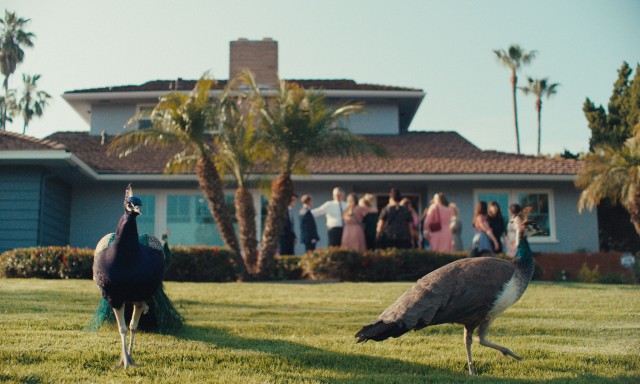
“You can easily get beyond the noise and roof damage and find a deeper appreciation for the natural world, right in your front yard,” Barlow explaining what the people of Arcadia taught her
Barlow comes to the film after more than a decade producing high-profile documentary work, including the pioneering brand storytelling project, The Avant Garde Diaries, and roles at Future of Film, RYOT, and Nat Geo. That experience is evident in Our Neighbors, the Peacocks, her directing debut. Formally, the film operates in a polished, public-television register that we sometimes look askance at – cleanly shot interviews, tidy thematic organization, a steady rhythm of anecdote and observation. But here, that clarity works to its advantage. Without a singular dramatic hook, the film instead builds momentum through accumulation, toggling between human testimony and the hypnotic, often absurd spectacle of the peafowl themselves. The result is a piece that, while not reaching for formal fireworks, remains consistently engaging; its construction across 20-minutes is tight enough that the material never overstays its welcome.
If there is a limitation to the approach, it is a certain repetitiveness in its coverage, as there are only so many variations on “they’re beautiful but loud” that the film can cycle through. Yet even this speaks to the underlying reality it depicts: a stalemate, a loop, a community perpetually negotiating the same question without resolution. In that sense, the film’s structure mirrors its subject.
Barlow’s allegiances are not hard to discern, but Our Neighbors the Peacocks resists the urge to resolve the tension it so clearly lays out. Instead, it leans into a modest but resonant idea articulated by its director that living alongside these animals might require “putting aside your own discomforts to find a deeper meaning in nature.” It’s not a radical thesis, but within the context of a culture that increasingly experiences nature at a remove, it lands with quiet force.