 Serafima Serafimova
Grief is a strange thing. It can lie dormant for years, settling beneath the surface, only to rise again when you least expect it. A sound, a place, a smell – and suddenly it spills over, pulling you back into something you thought you had long since made peace with. We’re told that time softens the sharp edges of heartache, that memories become easier to carry, but more often than not they simply shift and distort, changing shape as they move through us. And it’s within that fluid, unpredictable space that Telsche finds its flow.
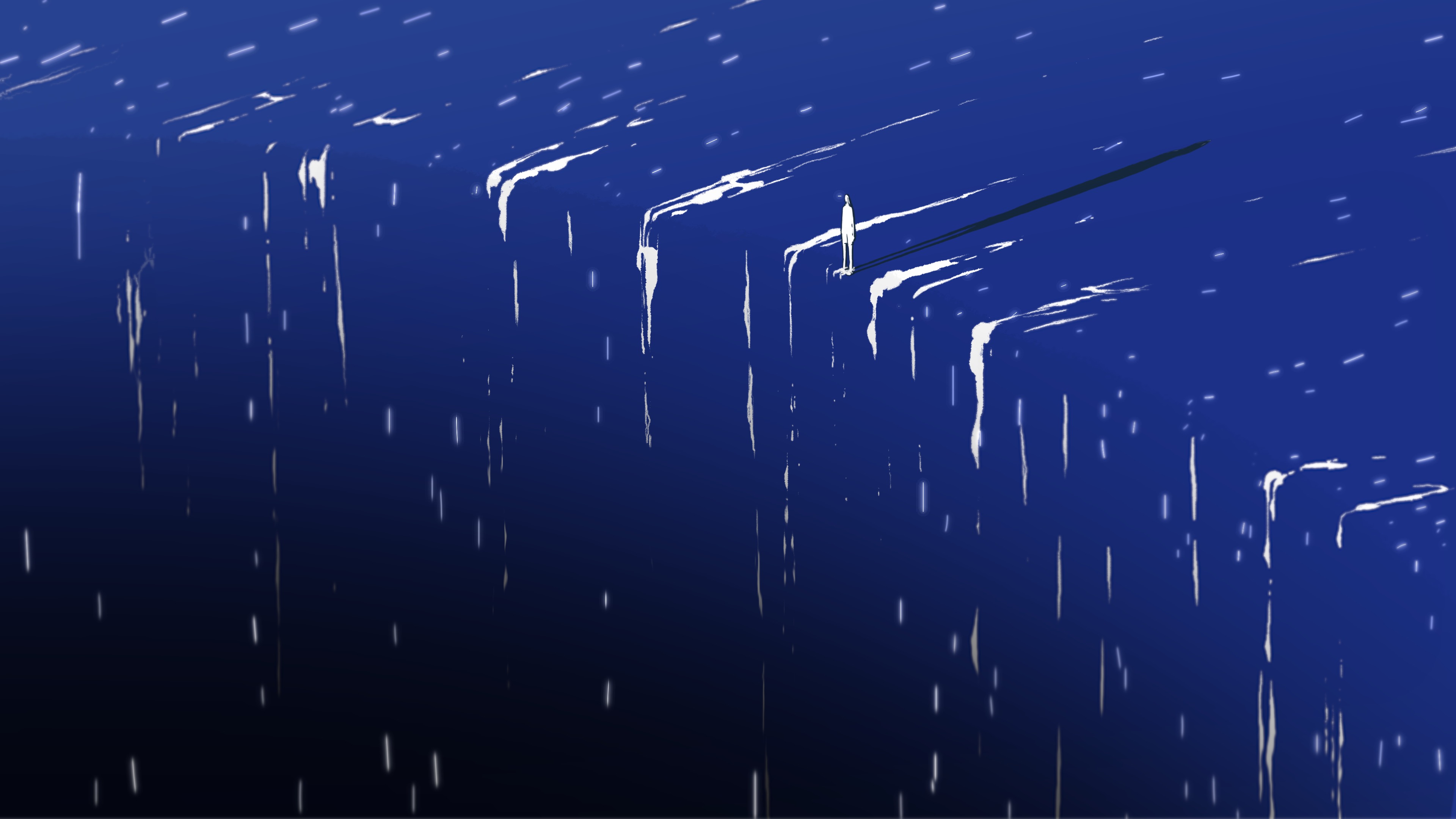
Directed by Sophie Colfer and Ala Nunu (Ahead), Telsche is a conceptual short that conveys the strange, lingering ache of loss and nostalgia in a way that hits close to home, even though its storytelling is abstract rather than literal. In just eight-minutes it makes this weight of memory feel tangible without spelling it out, and the animation is a thing of beauty: shapes and colours change and shimmer, sometimes solid, sometimes fluid, so that a single blue can feel like water one moment and a yawning void the next. Every design choice feels carefully considered, and everything comes together to make the story feel both personal and universal. It’s easy to see why this beautifully rendered meditation on grief has already made waves at Annecy, Anima and more.
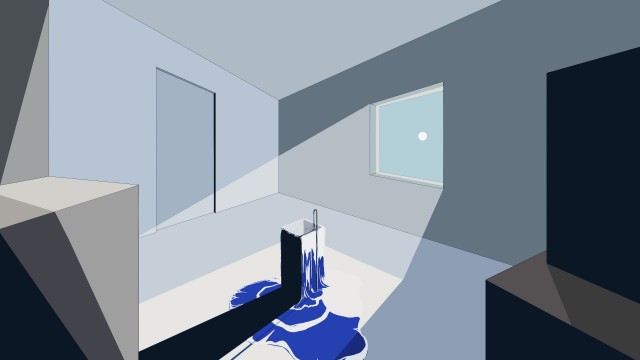
“We felt that the clean 2D digital style worked best to emphasise the bleak contrasts of this world” – Colfer & Nunu discussing their aesthetic
Telsche follows a young girl chasing a memory of her mother. The story is minimal and dreamlike, loosely charting her journey as she notices a stone carved with her mother’s face at home, rushes outside to the salt flats, and sees her vanish into a blue void. Determined to follow, she dives into dark, twisting tunnels underground, uncovering a hidden world that brings her closer to a reunion.
The story is actually rooted in Colfer’s own memories. After moving back to Hong Kong, where she was born and grew up, she was reunited with the vast sea of her youth and the memories of her family, especially her mother, a Japanese diver, and her father, an English sailor. “One of her earliest memories with her mother was of watching pearl divers in Japan”, the directors shared with S/W.“They would dip and descend in their white uniforms, without tanks of air, and collect pearls from the depths. These concepts of memory and forgetting therefore permeate the entire film, reflected visually in the contrast between light and dark and in the choice of still, wide shots, wherein the subjects are barely visible, on the verge of being seen but as of yet unremembered.”
But the film doesn’t rely on distance alone. It counterbalances these expansive compositions with close-ups that pull us into Telsche’s interior world, creating a push and pull between detachment and intimacy. While the wide shots place her within an overwhelming expanse, emphasising her smallness and isolation, the tighter framing invites us to linger with her, to feel the weight of what she carries.
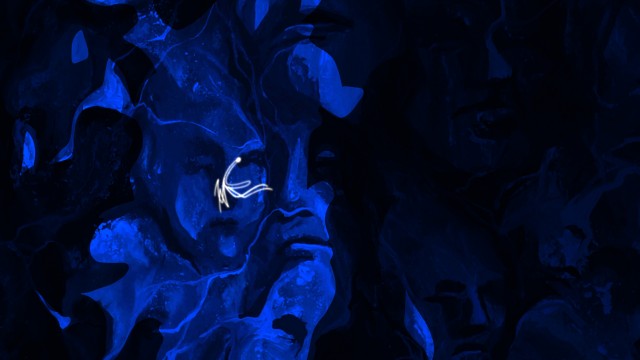
“Our collaboration took (and continues to take) place across a distance spanning thousands of kilometres and an eight-hour time difference” – the directorial duo discuss working together
Pulling back, beyond these compositional choices, there’s something to be said about the sheer level of craft on display here. What makes Telsche so striking is just how much care and precision sits behind its apparent simplicity. This is anything but effortless. Every scene carries the weight of countless hours of animating frame by frame, of trial and error and a good helping of raw talent, and you can feel it in the way the animation moves and breathes. The limited colour palette, rather than restricting the film, does the opposite. It forces a kind of creative discipline that pays off, pushing the animators to find depth, contrast and atmosphere in every scene. Shapes and colours become more than stylistic choices too – they act as storytelling tools in their own right, continually reshaping the space around the character. Paired with the eerie, echoing sound design, which seems to stretch and bend the space even further, the result is deeply immersive. It’s a film that understands exactly how to use its tools, and never wastes a single one.
And when it ends, Telsche doesn’t so much conclude as drift – leaving behind an impression rather than an answer. Like grief, it resists being pinned down, instead settling somewhere deeper, where feeling outlasts understanding.