
 Céline Roustan
A film that looks to capture what the director describes as a “continuous sense of heightened, highly subjective perception”, Daniel Newell Kaufman’s Runon is an extremely stylish and cinematic exploration of inherited trauma. Set in a quintessentially American location, this 12-minute short follows an anxious mother and her seemingly disorientated son, as they wait for their bus in a Greyhound station late at night. It’s clear from their behaviour they’re escaping someone or something, but like the confused boy at the centre of this short, we only put the pieces of the puzzle together as the story unfolds.
Intrigued by family cycles and passed down trauma, it was only after experiencing a personal tragedy that Kaufman got a clearer idea of how children internalize their parents’ emotional worlds, and sometimes confuse them for their own. With this fresh in his thoughts, the writer/director steered his narrative in the direction of how one breaks those patterns and the struggle that ensues. Highlighting what he calls an attempt “to escape some epigenetic loop, and the painful catharsis of breaking free”.
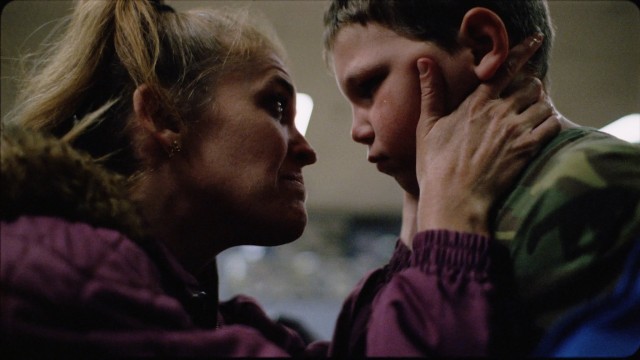
Runon focuses on the relationship of a Mum and her young son and the palpable chaos of their situation.
In writing Runon, Kaufman has created two-layered, believable characters, their interactions laced with a subtlety that supplies the viewers with the necessary information, without it ever feeling forced. From the dialogue alone, we get a good sense of their backstory, even though the specifics are not clearly laid out, the emotional chaos of the environment is quite apparent. To paint his story and capture that aforementioned chaos the filmmaker amplifies his screenplay with some truly exciting craft. This is where the film really becomes enthralling and expands to be more of a totally immersive experience.
Utilising every filmmaking tool in his arsenal, Kaufman perfectly captures the panic and confusion of his two central characters, recreating the young boy’s experience and submerging us in his world. Though the film’s narrative isn’t exactly brimming with originality and ingenuity, the production more than makes up for it with an aesthetic that is notable in the moment and impressive with hindsight – I actually really recommend rewatching it to fully appreciate all the subtleties of the style. From the sound and the score, that come and go and give us such an insight into the boy’s perception of the situation and what he is focusing on at any time, to the outstanding cinematography, we live the film through the boy’s eyes, seeing and feeling as if we were in his shoes.
This chaos he lives in is depicted in such an accurate manner that it escapes from the screen, disturbing our mood and unsettling our emotions. We are in the midst of it seeing it, hearing it, feeling it, understanding it, sitting idly as we watch Luke putting the pieces together, trapped in the cycle his mother created. As the point of view alternates between Luke and a more omniscient one, it allows the audience to get a greater understanding of both the boy and his situation, from a distance. These layers increase our empathy as viewers and make the unusual ending still emotionally satisfying, as we feel that sensation of breaking free from the situation Luke finds himself in and has most likely been in for a while. With very few words, all through his eyes, we witness his train of thought and though the film wraps on a bit of a question mark, emotionally Kaufman still delivers a climax, followed by a tiny sense of relief.
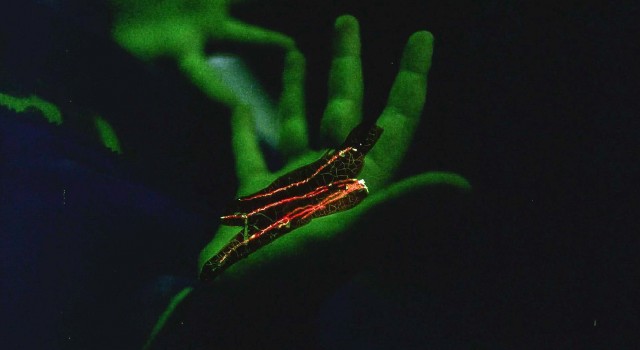
The aesthetic of Runon is heightened with animated titles and lines scratched directly on the film negative
“Given my own love of greyhound stations – those singularly American fluorescent limbos – I wanted to really ruminate on their textures and tones”, Kaufman tells us while discussing the origins of the film. As a foreigner, travelling on those late-night buses, there is indeed something about Greyhound stations that can only be associated with the American experience and Kaufman captures it well, without overdramatizing it. Shot on 35mm, the film serves up dream-like visuals, that float across the screen like memories and ultimately give the film such unique flair.
Runon was part of the 2020 SXSW shorts program and has since debuted online as a Vimeo Staff Pick Premiere. Daniel Newell Kaufman is currently developing a feature based on this short film, while shooting a documentary about Stone Mountain in Georgia.