 Jason Sondhi
Typically, we seek to inspire trends, but this is one that we’re reactive to. Typically these collections also aspire to be evergreen, but today’s is very tied to this moment, which is a clear coming-out-party for a particular class of creator.
Curry Barker is a sensation. Obsession, the horror feature he made for under $1M, has gone toe-to-toe with a Star Wars film at the US box office. Released by Focus Features, it is a massive hit, and Barker has reportedly been offered “8 figures” site unseen for his next pitch. It is the biggest surprise in the US theatrical ecosystem since Iron Lung, a self-distributed indie horror film by the artist Markiplier, caught Hollywood unaware by grossing $50M+ at the start of 2026. Yet both films will be overshadowed this weekend by Backrooms, a horror film directed by 20-year-old Kane Parsons for A24, which is tracking #1 at the box office with an estimated $40M – $50M in just its opening weekend. What could be the connecting thread for these three breakout hits…?
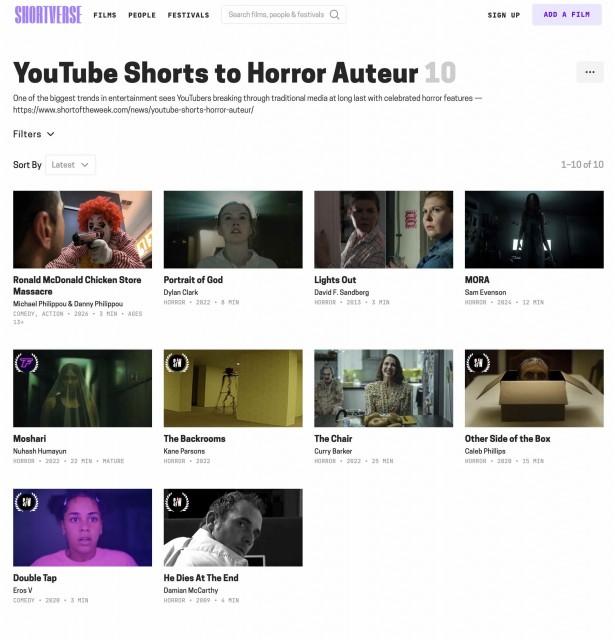
Ok, the title of this post and image above spoiled it, but the question is slightly nuanced. The notion that Horror is the genre of the moment for original stories and fresh talents is not news to anyone paying attention. Blumhouse has launched successful horror franchises on the cheap for years, and we’re roughly a decade out from the crystallization of “elevated horror” as a concept, which has been a transformative pillar of revenue for the mini-major studios like A24 and Neon known for supporting auteurist cinema.
This trend is also not as reductive as stating that these filmmakers come from the short form either. Contemporary horror is littered with directors who broke out via shorts, whether that be as far back as Sam Raimi, younger veterans like Blumhouse’s ace, James Wan, the vanguard of elevated horror like Robert Eggers and Ari Aster, or even newer talents, like Parker Finn of Smile.
Instead, the shared bond is that these filmmakers largely sidestepped the development process of film schools and elite festivals to build a following on YouTube. They shared their creative journey in real time, transparently, and in mutual development with their audiences.
Now that the trend has been distilled, everyone wants to find their example. Dylan Clark has been tabbed to adapt his online hit, Portrait of God, for Universal, and offered the Blair Witch Project reboot. Neon just released Hokum by S/W alum Damien McCarthy, who can be seen as an early precedent for this trend, and has now signed a deal with Sam Evenson to adapt his YouTube hit Mora.
To get you up to speed, we’ve put together this small collection that gathers a representative piece from creators who, like Curry Barker, have now broken out, or like Clark who are on the cusp. We supplement them with older examples in McCarthy and David F. Sandberg, who represent the prototype of this trend, and put forward three S/W alums that, while not prominent YouTubers themselves, have seen their work perform very well online and possess some of the same sensibilities that I think have made this current crop pop—Caleb J Phillips, Eros V, and Nuhash Humayun.
Going through the collection, it’s hard to find linkages in subject or style, which then directs one’s curiosity deeper onto their single commonality. Beyond trend-chasing, what does the YouTube of it all mean? Is it just a talent-surfacing mechanism? Does the algorithm and the resulting views and comments replace festival programmers and tastemakers like Short of the Week? A different angle of inquiry ponders whether the work of these artists is meaningfully shaped by the audience—that the process of quickly creating for public consumption and receiving instant, data-rich feedback is a perfect iterative lab for refining one’s technique and discovering what really works. A cynical take is that the existence of the audience itself is all that matters and going after these filmmakers is risk mitigation in the same way that working with established IP or casting a big name is. I think that’s reductive; Hollywood has tried and failed to crack the influencer nut over the past decade, but folks like Barker and Markiplier do possess a parasocial aspect to the audience bond that, for fans, is deeper than simply “liking” their work.
I find these all to be interesting, and the truth is likely that they all play a factor in this current moment. However, the most convincing argument to me might be Occam’s Razor—horror is a youth genre, and all the kids are spending all their time on YouTube. Is it as simple as that?