 Jason Sondhi
Short of the Week was born in 2007, the heyday of the hipster—skinny jeans and band T-shirts were the uniform, complementing personalities defined not only by what you liked but, importantly, when you liked it.
And, if we’re being honest, short film fandom is kinda hipster. We like shorts because they can be scrappy, original, and risk-taking, but they are relatively obscure, so there is a certain flattery towards one’s discernment and taste when cultivating a deep short film knowledge. Also, of course, opportunities abound for smugness when talents break out since you knew about them before others did.
2000s fashion is making a comeback, and it’s interesting to see that the directors ascending Hollywood’s status ladder had their formative film experiences during this period. Four of the five nominees for Oscar® Best Director released their debut short film in the 2000s. This generation of filmmakers was the first to grow up in a digital, streaming era, and as we remarked three years ago in our retrospective on the DANIELS, now, for the first time, the most admired film talents in the world have easily accessible short films on the internet.
So, as we pay attention to the current class of Oscar® nominees and wonder if Sam Davis or John Kelly can ascend to the level of globally respected auteur, it’s also fun to look at the short films of those who are currently the toast of the town—both for enjoyment, but also education, especially if you are an emerging talent who would like to see what it took for these artists to begin to make a name for themselves.
We’ve collected early shorts from the five nominees into a Shortverse collection, and they represent interesting and varied paths to their current success. More info below:
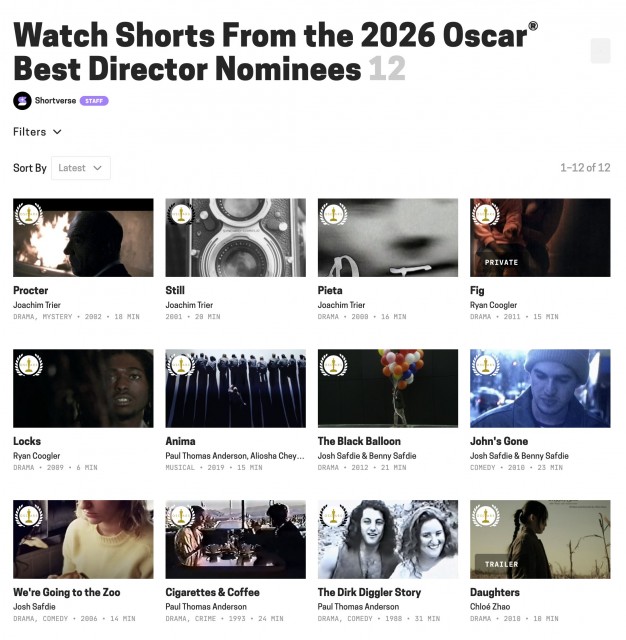
Click to visit the collection on Shortverse
Paul Thomas Anderson: The elder statesman of the class, The Dirk Diggler Story (1988) is pretty rough and not really at all similar to what, nine years later, would become Boogie Nights. But, it is a fascinating early artifact, and a testament to the longevity of creative ideas. Cigarettes & Coffee (1993), on the other hand, went to Sundance and aspects were almost directly adapted into the opening scene of the filmmaker’s debut feature, Hard Eight. As a bonus, we also have Anima (2018), a music/performance piece in collaboration with Thom Yorke that is on Netflix.
Ryan Coogler: The filmmaker’s two IMDb-listed USC film school shorts are included. Locks (2009) is available on Vimeo, and while modest, the 7min Tribeca-selected short is powerful, and predicts some of the themes later explored in the filmmaker’s Sundance breakthrough, Fruitvale Station. Fig (2011) was more acclaimed in its time, winning the HBO Short Film Competition at ABFF and the DGA Student Film Award, and it streams for free on Kanopy if you have a library card from a participating institution.
Josh Safdie: Safdie, along with his brother Benny, has a ludicrously long filmography stuffed with skits, experiments, short docs, and other visual artifacts. Diehard fans have been obsessive in collecting them all, but we’ll stick to three films for this collection. We’re Going to the Zoo (2006) is notable as the work where the director’s POV began to gel. In an interview with Le Cinema Club, he says, “It was THE moment when I figured out how to speak ‘film.’” John’s Gone (2010) is the film that immediately followed their breakout debut feature, Daddy Longlegs (2009), and played at Venice—something pretty rare for American directors. Benny’s performance in it is something of a prototype for the type of hustler eventually portrayed by Robert Pattinson, Adam Sandler, and Timotheé Chalamet in future features. Finally, we end with the brother’s Sundance and SXSW-winning homage to one of the most famous short films of all time, with 2012’s The Black Balloon.
Joachim Trier: Trier, like Spike Jonze before him, got into filmmaking through skateboarding videography before leaving Norway and attending film school in the UK. Courtesy of the NFTS, we have three of Trier’s student shorts, which also represent the beginning of his partnership with Eskil Vogt, his longtime co-writer. Pieta (1999) and Still (2001) are worth watching, but Procter (2002), made immediately upon graduation, is the essential one, as it represented the filmmaker’s continental breakthrough, winning a top prize at Edinburgh and being nominated for the European Film Award.
Chloe Zhao: The one hole in our collection today is Zhao, who does not have any of her four credited short films available to view in full. Information about them on the internet has largely been wiped—not on purpose, one assumes, but the filmmaker’s old website no longer works. We’ve included the film page for her NYU student short, Daughters (2010), for the sake of completeness, and there is a trailer for it, which evokes a strong Raise the Red Lantern vibe. It won Best Student Short Live Action 15 Minutes and Under at the 2010 Palm Springs Film Fest, and this Indiewire news piece is a fascinating time capsule. Written by Eugene Hernandez, who is now the Festival Director at Sundance, so many of these winners ended up being Short of the Week picks! But, I did not attend and have no memory of Zhao’s film. I think the only place to see her shorts now is in person at Clermont-Ferrand’s video library, something I might put on my to-do list for next year…