 Rob Munday
Having been at the 2026 Ouray International Film Festival to present the inaugural Short of the Week Award to the filmmakers behind WE BUY GOLD, it quickly became apparent that this prize isn’t simply about championing a single short film – it’s about recognising the filmmakers behind it. The award was created to spotlight emerging talent and celebrate the directors we believe are poised for exciting careers ahead.
With that in mind, we couldn’t have asked for more deserving inaugural winners than David Huang and Albie Smith-Chang. Now that We Buy Gold is live on Short of the Week, we wanted to shift our focus from the film to the filmmakers themselves. In this interview, the co-directors discuss their paths into filmmaking, how their creative partnership came together, and what audiences can expect from them next.
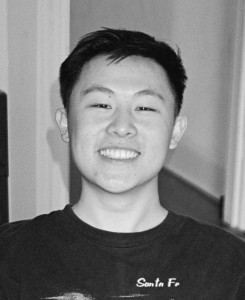 David Huang is a narrative and doc director. His short documentary, Re-Opening, commissioned by the Asian American Documentary Network, was acquired by PBS World Channel for upcoming broadcast. His most recent film, Rock Springs, centered around the events of the 1885 Rock Springs, Wyoming Chinese Massacre, is currently on the festival circuit. Previously, his films have screened at festivals across the world, receiving awards such as the British Film Institute’s Future Film International Special Mention, The Kyoko Arai Fund, and the HEAR US Award.
In the past, he has also directed and produced content for brands and organizations such as DoorDash, the United Nations, PBS, The World Channel, Current, coinbase, Drexel University, and more.
***
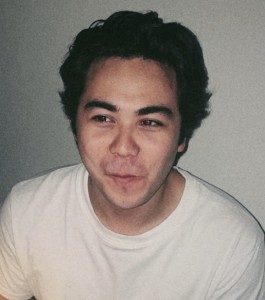 Albie Smith-Chang is a writer, director, and producer who studied at NYU’s Tisch undergrad Film and TV program. He is interested in creating hybrid films that exist somewhere between documentary and fiction.
Albie associate-produced the Oscar-nominated short documentary, The ABCs of Book Banning. Recently, he was the lead researcher on the documentary Nuns vs. The Vatican, which was nominated by TIFF and supported by the Sundance Edit and Story Lab.
For his short film Vagababy, he collaborated with Lou Romano, who voiced Alfredo Linguine in Pixar’s Ratatouille.
***
Now that we’ve introduced our two filmmakers, let’s get to know them a little better through five questions exploring their filmmaking journeys and their approach to making WE BUY GOLD.
DH: I can’t remember the specific moment I decided to be a filmmaker – I think it might have been when I was watching Nemo or The Incredibles for a millionth time as a little kid. But I do remember the specific moment I decided to be this particular kind of filmmaker. I had just watched this incredible movie in theaters, BlackBerry, directed by Matt Johnson. And I went home determined to watch his other films, and started with The Dirties. I was really blown away – I had no idea you could make a fiction film in this way, with non-actors and real locations, and with the aesthetic sensibilities of an amateur doc filmmaker, it was just so magical and totally believable – I was completely immersed in the film. I think I came up with the idea of shooting WE BUY GOLD in this way shortly after.
Albie Smith-Chang: My father is a painter and visual artist, and he worked on this passion project film of his for most of my childhood. He filmed pieces of it over many years and I acted in it at different points of my life. I’d always been surrounded by movie-making, so there was this subconscious assumption that I would continue to do what he’d exposed me to. So, thank you, dad. And I’m going to have to echo David and cite Matt Johnson’s The Dirties as a key moment of eye-opening for me as a filmmaker. When David showed me that film, it really unlocked a lot of inspiration and drive to be like, wait, we could try to do something like this. We don’t need any money, we just need a world to explore and two friends who can translate their real life chemistry to an audience.
The narrative of WE BUY GOLD is so unique that it feels as though there must be a personal connection behind it. Can you tell us a little about the inspiration for the story and why you wanted to tell it?
DH: I’ve been collecting coins since I was 6 years old. Thanks to this life-long interest in coin collecting, I’ve met a lot of really interesting coin dealers and collectors, and have heard and lived a lot of weird, pretty fascinating coin-related stories. At the end of the day, it’s a super specific, very strange little niche-hobby-universe, and I thought it would be a lot of fun to see it play out in a cinematic(ish) way. Particularly if we wrote the main character as a terrible person, one of those bottom-of-the-barrel, scam-y kind of dealers that are the worst nightmare of an old lady who’s just inherited her husband’s coin collection.
“It would be impossible for someone else to replicate our work, even with an unlimited budget and every Hollywood asset in the world”
We hoped to expose people to a world that we dearly loved, as to experience a location, process, and community that you’ve never seen before is one of the most exciting things in cinema. And obviously, we wanted to make people laugh as well. This is a film about two close friends, so we really wanted to capture the heart and laughter of a genuine friendship. We wanted to make something that was so incredibly personal, so dependent on our access and our worldview and who we are as people, that it would be impossible for someone else to replicate our work, even with an unlimited budget and every Hollywood asset in the world.
It’s not just the story that makes WE BUY GOLD so memorable – the film’s visual approach is pretty wild as well. Where did the idea to shoot on iPhones come from and was there ever a point where you considered shooting it in a more conventional way instead?
We were heavily inspired by the work of filmmakers such as Matt Johnson, Sean Baker, and the Safdie Brothers, and we really wore those influences on our sleeve. We wanted to cast non-actors, we wanted to shoot in real environments, and we wanted to shoot super scrappily. We actually got even scrappier as we continued to film – early in pre-production, the film resembled more of a Makoto Nagahisa/Daniels-esque maximalist romp – we were planning to shoot on a small cinema camera, and even filmed a few scenes this way early on in production.
At one point, however, we shot an opening scene on an iPhone – it was supposed to be the opener of the film, shot from the perspective of one of the characters, that would then transition into a higher production value/polished style of filmmaking. But there was something about shooting on the iPhone that we thought was not only fun, exciting and fresh, it also looked unique – it was something we had really never really seen before.
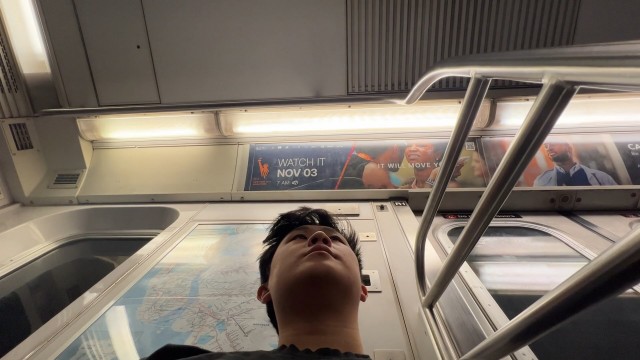
WE BUY GOLD uses its iPhone cinematography to capture scenes from unusual and unexpected angles
We’d seen iPhone filmmaking from the likes of Sean Baker previously, but it was always extremely polished, fully-kitted out iPhone footage that looked cinematic and beautiful – and we instead took advantage of the iPhone’s small profile, choosing angles and shots that utilized the iPhone’s ability to be placed in a lot of places where it would be difficult to get a cinema camera into.
WE BUY GOLD was born out of the limitations of shooting in real environments. Even though the film is scripted, the background noise, texture, and actors are not – although we had a script, actors were allowed to ad-lib and improvise at their own will – nowhere in our film was anything “word perfect”. In doing this, we were able to capture so many authentic, natural line deliveries.
Also, by owning our own production equipment, and keeping the cast and crew so minimal, we were able to reshoot literally any scene we weren’t happy with – and although that came with a certain aesthetic cost, to be able to reshoot anything we wanted was truly a huge superpower.
I’m always interested in hearing how co-directors work together on a film, and WE BUY GOLD feels like a project that thrives on collaboration, both in front of and behind the camera. Can you explain a little about how you shared responsibilities throughout the production and what you see as the biggest advantages of co-directing a film?
Two heads are better than one. In our case, maybe ten heads are better than one – this was the most collaborative film either of us have ever worked on. Between the crew and the cast, everyone had input on the story and the creative decision making behind the film.
With two director-writers, the biggest advantage was really double the ideas. Anything we thought of that was even mildly interesting to the other we would put down in the script and shoot, and if it didn’t work – we always both agreed to cut it. Once we put anything into the timeline, we were pretty much in total agreement whether something played well in the film or not.
“We needed the film to flow and move at such a quick clip there wasn’t much room for anything that didn’t drive the story forward”
During the actual production itself, it was the exact same thing. Any suggestion not in the script that either of us has, we’ll try it. It’s particularly easy given that one of us was the main actor who was in front of the camera in almost every scene in the film. And if the suggestion works, again, we both agree it works once we see it in the edit. Our editor, Suzie Bhojwani, is the reason the film is any good at all. She cut so much of our mediocre material and really shaped our story.
It also helps that we’re really harsh with ourselves as well – so much material that we honestly really like but just doesn’t meet our standards ends up on the cutting room floor. We needed the film to flow and move at such a quick clip there wasn’t much room for anything that didn’t drive the story forward or that we didn’t find really, really funny.
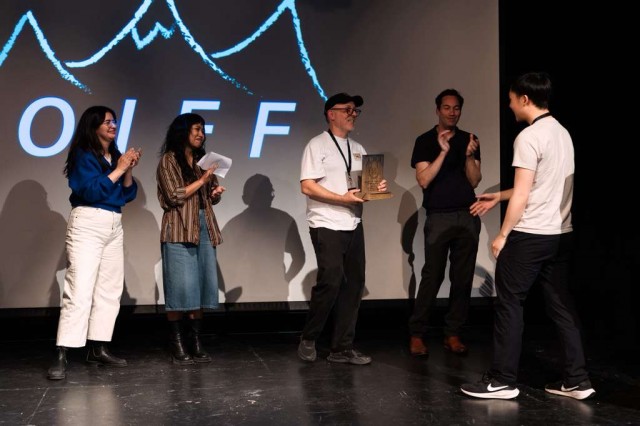
Co-writer/director David Huang (R) on-stage at the Ouray International Film Festival accepting the first-ever Short of the Week award from Managing Editor Rob Munday
I mentioned this at the awards evening in Ouray: while we love WE BUY GOLD, this award isn’t just an acknowledgement of this particular film, but of the exciting talent you both possess as filmmakers. With that in mind, are you working on any new projects you’re particularly excited about, or do you have any future plans you’d like to share?
We’re so honored to have won this award, and we were ecstatic to be in the company of so many incredible filmmakers at the festival – to be chosen by you guys as the inaugural winners of the Short of the Week award is mind blowing to our team. We are currently in pre-production/production (same thing for us) on the feature length version of WE BUY GOLD – it’s going to be shot in the same style, but even more scrappy and ambitious, with much of the same cast and crew. We hope to involve some new collaborators that we’ve met along the festival circuit as well – we’re going to fill the film with so many talented new people that we can’t wait to work with, either again or for the first time.