 Jason Sondhi
Cannes is a hallowed name in cinema—you don’t need me to rhapsodize about that. Winning the Palme d’Or is a legacy-clinching achievement for a director, either as a capstone to a legendary career (Kurosawa, 1980) or the coronation of an exciting new one (Östlund, 2017). It is a commercial boon as well, essentially ensuring global distribution for its winner and propelling numerous box-office successes. You know this, yet often forgotten is that there are multiple Palmes given out every festival…
With Cannes starting this week, short filmmakers from around the world will descend on the seaside town to experience the glamor of the event and to partake in the influential Short Film Corner / Rendez-vous Industry programming. Thousands of shorts are at SFC, and dozens of shorts are programmed in sidebars and satellites. But the jewel of the Cannes short film scene is the ultra-exclusive Official Selection, where the top jury prize winner receives the Short Film Palme d’Or. We’ve collected all the winners of this prestigious prize this century into a Shortverse playlist that you can browse, with 14 of the 25 winners available to stream for free.
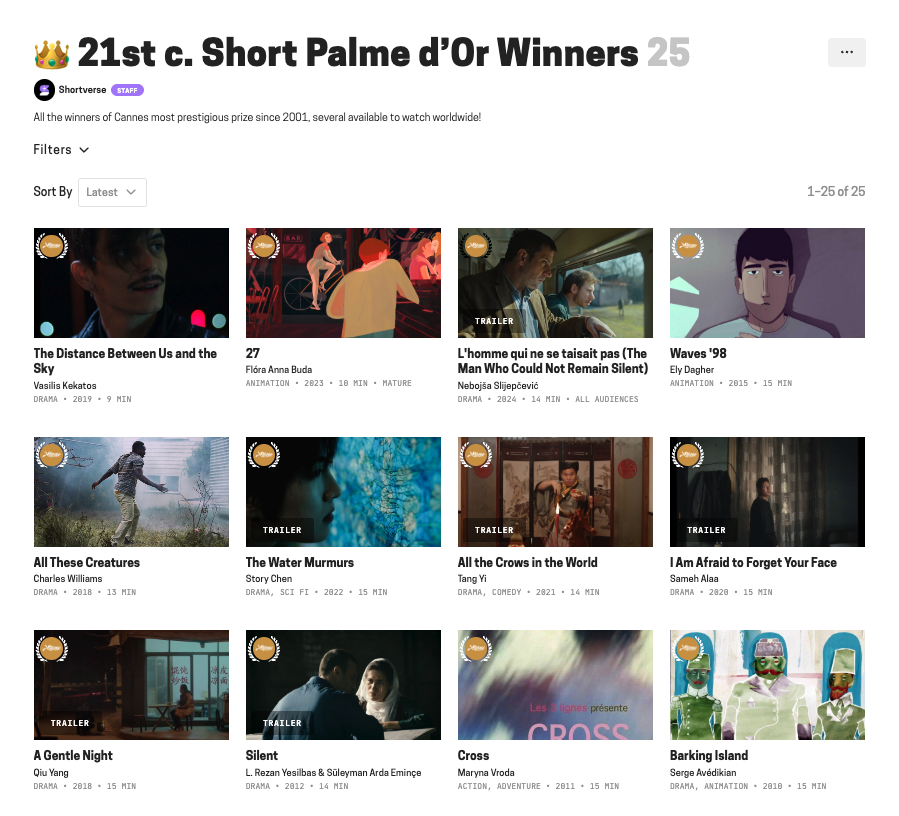
Click on the image to view the Collection on Shortverse
Putting this collection together made us consider the larger context of the award. If Cannes is the pinnacle of film fests on the feature side, does the same hold for shorts? It would be disingenuous to suggest that the Short Film Palme is of equal career or cultural weight to its feature sibling for a multitude of reasons—the lesser position of short films in the cultural firmament first and foremost, but also for reasons more germane to the event itself, its programming history, and the nature of the short film landscape.
I’ve been a guest at film festivals on most every continent (still awaiting an invitation Antarctica!), but I have yet to visit Cannes. I also associate with, but would not consider myself part of, the professional short film community of festival heads, sales agents, and buyers that organizes around large, mostly European fests like Cannes, so maybe this invalidates my perspective. Still, from afar, I probably romanticize the Cannes short program beyond its actual place within the short film ecosystem.
On the one hand, the Short Palme is maybe the most exclusive prize in all of short film—only ten entries make it into the official selection each year, from a healthy 3000+ entries (strict premiere requirements do shrink this number), and the reputation of the larger event means the festival usually has first dibs on its picks. While individual films are sometimes not to my taste, the program is always strong, and its selections invariably go on long and impressive festival runs. However, this selectivity is undermined in the popular imagination by confusion over the numerous satellites orbiting the fest and most notably the non-curated Short Film Corner market, where the perennial confusion caused by filmmakers advertising that they “got into Cannes” when referring to the SFC has become a meme over the years.
Perception aside, the enduring influence of its programming is also up for debate. The films are of quality, but that is an irrelevant criterion at this level. Do they shape trends or culture? Do they herald exciting or important voices in global cinema? Do they leave a lasting legacy? While I hate to utilize the Oscars as a barometer for anything, it’s notable to me that the feature Palme winner is nominated for Best Picture most every year, while only two Short Film Palme winners have been nominated this century. On a more basic level, I don’t see a lot of directors who went on to become “household names” among this collection of Palme-winning directors. Compared to Sundance’s role as a launchpad for recognizable directing careers and its centrality to the American indie-to-feature pipeline via the Sundance Institute, Cannes’ short competition often feels more like a snapshot of contemporary international art cinema than a farm system for future celebrity directors.
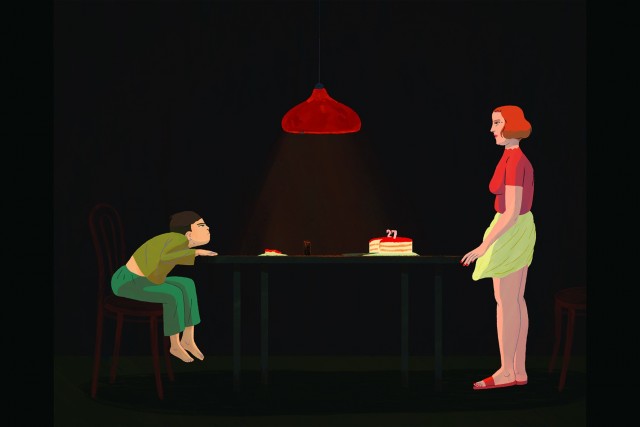
27 by Flóra Anna Buda won the Short Film Palme d’Or in 2023
I hypothesize that the exclusivity of Cannes works against itself in some ways. First, by maintaining such a small program, they deny themselves “at-bats” in the quest to discover future important filmmakers. It’s simple odds—Berlin typically has three times the number of shorts, Sundance has 6x. More controversially, I also think that being selected to Cannes hurts the ultimate cultural legacies of these films. Because of the exclusivity and because the brand of Cannes is so prestigious, almost every official selection ends up selling very well, so they get tied up in numerous rights and broadcast deals that prevent them from going online.
More than most celebrated festival shorts, I’d argue that films that play Cannes are strangely underseen—they succeed wildly on the circuit, but compared to selections from other major festivals, they don’t as often receive the sort of broad post-festival discovery and appraisal of a typical Short of the Week selection or Vimeo Staff Pick. Am I biased on this point? Undoubtedly. But we all live online now, and this is the fundamental battleground of culture and attention. In that sense, the question isn’t simply whether Cannes selects great films—it obviously does—but whether prestige and scarcity still translate in our contemporary environment of cultural circulation.
I think of my experience with Chienne d’histoire. The Palme-winner in 2010, Short of the Week was three years old at the time, and I was still unconnected to the entrenched short film world. Nevertheless, I became fascinated with the short and would trawl the web searching for it at least once a month. That’s just what it was like back then—I kept a list of shorts I would track, and the dopamine rush when sometimes the film would miraculously appear was unreal!
But Avédikian’s short never did appear. I think I dutifully continued looking for it for 6 years before giving up. Now it is available on Arte, and I could watch it using a VPN if I wanted to, but, strangely, the impetus is gone. I still have yet to. Fundamentally, I think Flóra Anna Buda and Miyu putting 27 online 18 months after winning the Palme was bold—I believe it will prove to be a boon for the short’s lasting influence, and a benefit to Flóra’s future career too.
These are somewhat awkward musings for a playlist celebrating 25 years of Palme d’Or prizewinners, but part of our mission is to not simply hype famous names but to describe for you the lay of this byzantine land as best we see it. Cannes is at once the crown jewel of the festival world, but shorts do not really have a mountaintop. Great short films, and by consequence, great emerging filmmakers, can and do emerge from anywhere, and this is one of the things we love the most about the form. The shorts at Cannes are excellent, and being programmed there is a great honor that can majorly benefit a filmmaker’s career. Yet for shorts, Cannes is less the definitive summit than one powerful node within a much wider and more diffuse ecosystem, a fact that, due to the event’s glamor, even I sometimes forget. This list of the 21st-century winners is a fascinating record of what is valued by the fest and its juries, and what has (or has failed) to pass the test of time with audiences.