
 Jason Sondhi
We’re subscribers to the theory that much of what we lionize as “creativity” in storytelling isn’t about inventing wholly new forms, but about the alchemy of combining familiar elements in unexpected ways. Dustie Carter’s pilot short for a proposed indie series, Heck to Death, is a sharp demonstration of that idea—its pleasures coming less from reinvention than from the novelty of what it chooses to fuse. The spark of its premise—the immediate recognition of what’s being mashed together—lands quickly and persuasively, creating an eagerness to see where the team might take it next.
Heck to Death is, at heart, a love letter to the DIY hardcore music scene. Carter, who once played in a small band, recalls “…nights packed into basements where identity, chaos, and community collided.” That connection gives the film an essential grounding and helps infuse the film with a necessary authenticity.
But the film isn’t interested in documenting the scene with anthropological rigor. Authenticity is abundant, but realism isn’t the goal. Instead, Heck to Death maps a familiar YA zero-to-hero arc onto this setting: a protagonist seeking belonging, an attractive love interest to impress, a rival to overcome. Tonally, it lands somewhere between The O.C. and a shonen sports anime, with the rhythms and emotional beats of both.
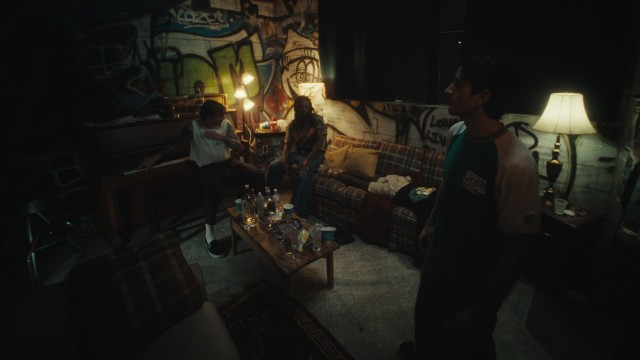
That may not sound especially radical, but exploring new subcultures via the safety of narrative familiarity works. Newness often emerges through reframing. Swap surfers for street racers and Point Break becomes The Fast and the Furious; here, the well-worn coming-of-age template is refracted through hardcore’s abrasive, communal energy. The result is a productive tension: the universal anxieties of youth—love, identity, status—colliding with a subculture that codes as aggressive, even dangerous. It’s a juxtaposition the film smartly leans into, and one that promises deeper exploration if the project expands.
Unsurprisingly, the film’s greatest strength is its energy. The climactic performance sequence is where Carter’s connection to the scene comes fully alive. A mix of locked-off compositions and kinetic handheld camerawork pop, creating a sense of manic, barely-controlled chaos, while the decision to cast performers who can actually play does wonders for the sense of immersion in the scene.

The film isn’t without its rough edges. Like its fictional band, Heck to Death is a scrappy, low-budget effort. The opening scene suffers from muddled audio, making it difficult to parse, and the protagonist remains somewhat generic. Performances vary, though Carter shows a strong instinct for casting in key roles, particularly the rival and love interest. Still, pilots operate by a slightly different metric than standalone shorts. The question becomes less about perfection and more about potential: do you want to spend more time in this world? Legitimate quibbles aside, the answer for Heck to Death is “hell yeah!”
The film arrives online today after a healthy festival run, highlighted by a prize at Colorado’s SeriesFest. For those tracking the still-emerging space of independent TV pilots, the festival remains its most vital showcase, even as larger players like Tribeca, SXSW, and Sundance have built out their own parallel tracks. Carter will return to SeriesFest next month with a new project, Octarine, but continues to develop Heck to Death. Here’s hoping that a robust reception online for this pilot short film can help create a groundswell of energy and support for that endeavor.