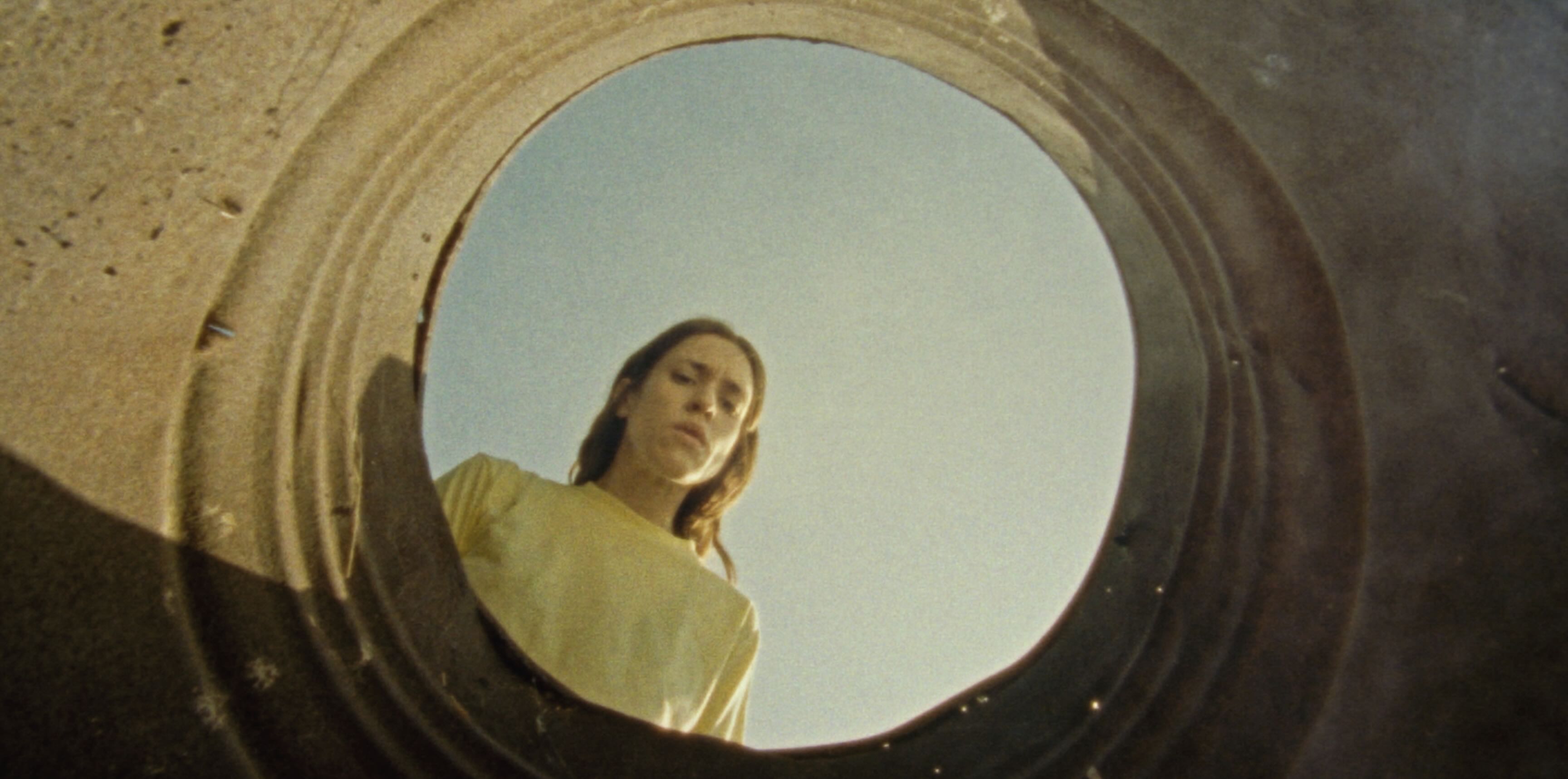
 Rob Munday
In March 2020, during the first month of COVID-19 lockdowns, Greece’s SOS Line 15900 – a national service supporting those affected by gender-based violence – recorded 325 calls, a 370% increase from the 69 calls received in the same month the previous year. Confronted by this sharp rise in violence in her home country, Greek writer-director Markela Kontaratou turned to filmmaking as a means of processing and expressing her response. The result is Scorched Earth, a London Film School graduation project that went on to screen at the Locarno Film Festival.
“The film was conceived as a Neo-Noir/Giallo that subverts the trope of a male voyeur”
Drawing on the visual and tonal traditions of Neo-Noir and Giallo, Scorched Earth is set in a sun-drenched Greek seaside town. It follows Stela, who returns home to focus on her studies, only to find herself increasingly disturbed by the presence of her abusive neighbour. As his violence towards his partner escalates, Stela becomes entangled in a possible crime, prompting her to take action seek out the truth.
Kontaratou’s intention with Scorched Earth is not only to foreground the ongoing realities of gender-based violence, but also to interrogate the ways in which such incidents are often mediated and sensationalised. As she suggests, the film critiques how violence is transformed into a “serialized, grotesque sensation” within media culture. To explore this, she turns to genre, incorporating elements of horror and thriller in order to “create a world that reflects the way in which femininities are treated in real life and in film.”
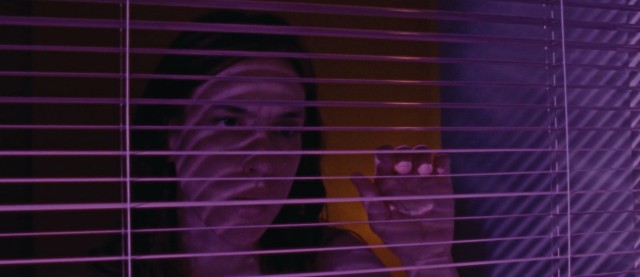
“Artificial was also our choice of purple moonlight, creating a surreal, mysterious atmosphere, connecting to the character of Vicky who also wears purple”, director Kontaratou discussing the production
With regards to production, the film adopts a distinctive aesthetic. Shot on 16mm, with a pronounced purple hue in its night sequences, Scorched Earth embraces a stylised visual language that introduces a layer of artificiality to an otherwise grounded subject. For Kontaratou, this is a deliberate strategy: “I tried to portray the female experience of the male gaze by putting the audience in the place of being conscious that they are watching something constructed.” Techniques such as “dirty” point-of-view shots, zooms, and expressive camera movements work to unsettle the viewer, continually suggesting the presence of something hidden within the frame.
The result is a deliberately voyeuristic experience, in which both the protagonist and the audience occupy a position of uneasy spectatorship. Kontaratou acknowledges that the film resists narrative closure, offering more questions than answers. As she explains, the intention is for viewers to recognise that these narrative decisions were “plot points rather than plot holes,” inviting reflection rather than resolution. The core takeaway from Scorched Earth is a persistent and troubling question: “why we are all so often silent onlookers when faced with situations of gendered violence?”