 Jason Sondhi
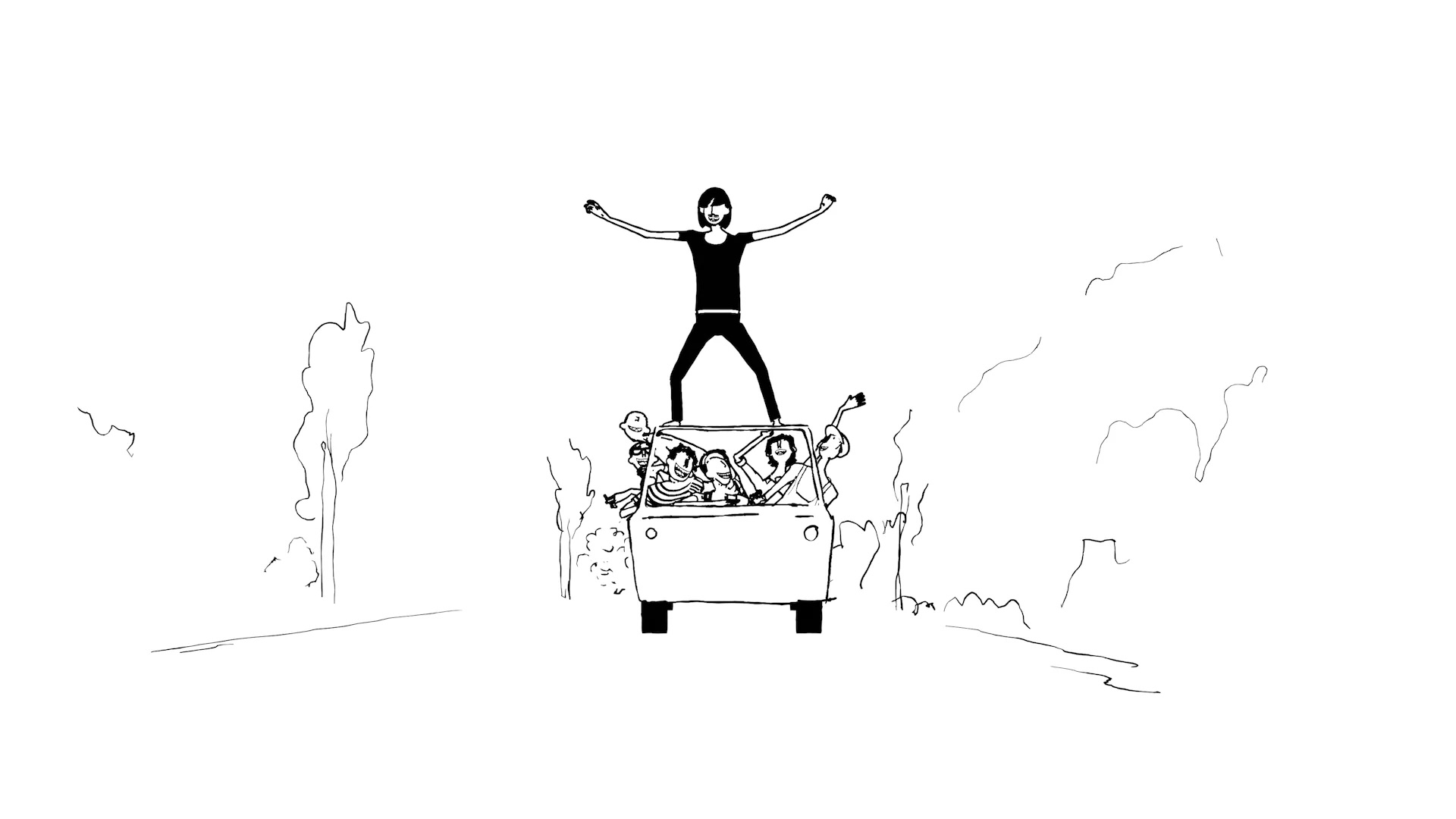
The insouciance of youth, set against the backdrop of a decaying communist Poland, provides a romantic backdrop for Jadwiga Kowalska to tell a lightly fictionalized version of her own family story in the Annecy jury-winner, The Car that Came Back From the Sea. Possessing a punkish energy and a strong soundtrack, the film is a triumph of tone, as the endearing antics of a group of young men, with their pure and simple desire to drive a piece of junk to the ocean, intersect with larger historical currents of political collapse and liberation.
It’s a vast canvas to explore, and perhaps counterintuitively, Kowalska approaches the film in a minimalist b&w line-drawing style. Animated minimalism can be a tricky proposition; it’s something we “admire” more frequently than we “love,” but Kowalska’s film is a fun approach— it’s actually 3D, and something about the lack of detail, the reliance on the main thrust of something, is fitting for the writing, which was created by combing through hours of interviews of her relatives, relating half-remembered stories and impressions.

When I asked my mother as a child why she left Poland, she always gave a very short answer: “There was simply nothing in Poland.”
Kowalska is Swiss, as is the film, and that proved challenging initially as the filmmaker relates in a Cartoon Brew interview, noting that, “…local funding institutions were not interested in a Polish film about migration,” while, conversely, Polish producers didn’t see what a Swiss 1st gen kid could say about the topic that was original or fresh. Kowalska concluded that in some ways, “it was a Polish film for the Swiss and a Swiss film for the Poles,” though I’d argue my affection for the film, and its success at festivals, which included an Oscar-qualifying win at Palm Springs in addition to its Annecy triumph, means that it is truly a film for everyone. While the details of 1981 Poland are fresh to me, youthful adventures, love, and revolution are universal.