
 Georg Csarmann
Maybe you’re familiar with the iconic absurdist viral video Amazing Horse, in which a cartoon character sings, “Look at my horse, my horse amazing,” before trying to persuade a woman to get on his horse. What if a skilled filmmaker picked up the inherent notion of that idea and brought it to its ultimate conclusion – adding emotional depth, a surreal atmosphere, and, of course, a little singing along the way? While Amazing Horse wasn’t the actual inspiration for Guy Kozak’s Melody of Love, it might as well have been its anarchist, spiritual forbearer.
In Melody of Love, a nightly campfire in a forest glade provides the setting for a potentially romantic encounter between a cowboy (John Reynolds) and the rancher’s daughter Peggy (Jane Levy). However, their moment of togetherness is continually undermined by the cowboy’s fixation on his horse Bullet (as the title card implies, the “Best Horse in Movies“), leaving him oblivious to Peggy’s advances. The tension between them is palpable and, at times, unpleasantly awkward, due to the cowboy’s obvious reluctance. As Peggy points out, he really is the silent type… until something akin to an anxiety attack leads to an unexpected, old-timey serenade under the moonlight.
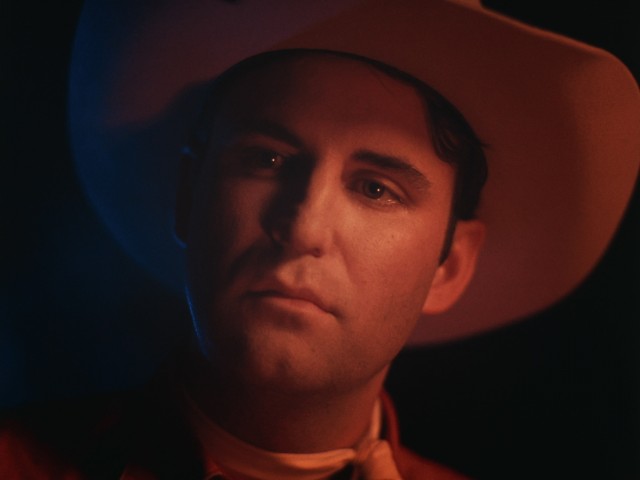
John Reynolds stars as the Cowboy in Guy Kozak’s Melody of Love.
One of the main reasons the blend of these various tropes works so well is the performer’s clear dedication to the slightly off-beat material. Shot in Academy ratio and bathed in a warm glow to evoke an old-fashioned aesthetic, the cinematography by Charles Akley Anderson lends a nostalgic air to the short, which is further elevated by Brandon Bost’s melodious score. Even the title design is reminiscent of Old Hollywood. To achieve the distinctive visual quality of Melody of Love, the film was shot digitally and then printed as an exhibition copy on 35mm, with the scanned print then blended on top of the original footage to create the final image. The attention to detail makes even more sense when one considers writer/director Guy Kozak’s background in production design and art direction.
I’ve been a curator for Short of the Week since 2010, and a fan of American independent film for much longer, and I can say that quirky comedy has emerged as a sub-genre that comes in all shapes and sizes. Over time, it becomes easy to distinguish between films that are weird for weirdness’ sake, and those that have something to say, using their peculiar humor to generate both awkward laughter and deeper meaning. Melody of Love is clearly the latter. The filmmakers know how to walk the line between not taking their short too seriously and remaining sincere about its intentions at the same time.
“The advances of the female characters (who tend to pine for the cowboy heroes) are almost never reciprocated”
Kozak revealed to S/W that Melody of Love was inspired by “Singing Cowboy films or ‘Horse Operas‘ of the 30s and 40s, starring the likes of Roy Rogers and Gene Autry.” He admits that even though he was trying to make a little fun of the genre, he genuinely likes these films and wanted to do right by them aesthetically.
“I love the world of those movies and the slightly clumsy way music was incorporated into them, and the fact that the actors were always playing themselves,” Kozak explains. “Most inspiring though was the strange role of sexuality in the genre, and the way in which the advances of the female characters (who tend to pine for the cowboy heroes) are almost never reciprocated. The cowboys in these films often seem uninterested in heterosexual romance, preferring instead the companionship of their horses.” The director acknowledges the irony of the cowboy being closely associated with “American ideas of masculinity” while often maintaining a “non-sexual presence onscreen,” and he intentionally sought to “play with that dissonance” in his film.
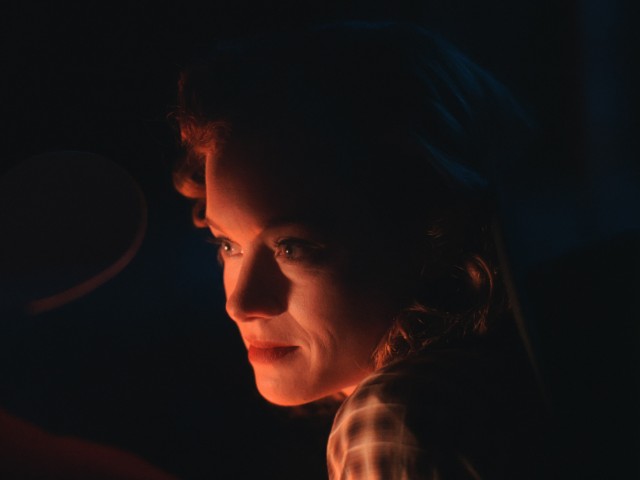
Jane Levy in the role of the Rancher’s daughter in Guy Kozak’s Melody of Love
To follow up on this thought with my own interpretation, I would argue that the topic at the film’s heart is at least as old as the Western itself: a man torn between the woman he loves (or could love) and his passion or purpose in life. In Melody of Love, this dilemma concerns the cowboy’s fascination with his horse, but the conflict itself is universal. It reflects the tension experienced by anyone pulled between career and love – the person willing to give up everything in pursuit of the ultimate goal, only to realize that it’s lonely at the top. In Melody of Love this conflict plays out as the cowboy prioritizes his admiration for Bullet over Peggy’s affection, even while being confronted with the possibility that someday he might realize that a man needs more than just a horse – despite insisting that he doesn’t get lonely, because his horse is the only company he needs.
Though it may seem silly to make the comparison, we can invite the implicit question into our own lives: who is our equivalent of Peggy, and what is our version of the cowboys’ horse? And can we make room for both? Or perhaps the simpler approach is just to enjoy the fun experience of (re)watching Melody of Love and swoon over the sweet-sounding duet between these two potentially star-crossed lovers.