
 Georgina Kritikos
Tender in its narrative, J.D. Shields’ Blue Hour shares an undertold story through the medium of photography. The title is a smart double entendre: a photographic term for an ideal shooting time, and a second interpretation referring to a moment of feeling blue.
Inspired by a conversation with a bereavement photographer, Shields set out to make Blue Hour, admitting that she was “fascinated and deeply moved” by all that she’d heard. Recognizing that there was a story here that needed to be told, she reached out to Now I Lay Me Down to Sleep, a non-profit organization that provides remembrance photography to parents experiencing the loss of a child, for guidance and advice. What emerged from Shields’ experience and research is a touching story that deserves to be seen.
I appreciate when narratives dole out information through visuals and actions, guiding us to piece together a character for ourselves. That’s exactly what’s done here as we observe the very real and relatable protagonist, Rene. She is first introduced in a short montage: photographing herself with a vintage camera as her space remains cluttered with boxes. We quickly learn vital details – here is a photographer who has recently moved. A meaningful frame of Rene photographing herself through a couple of mirrors lingers, packed with curiosity.
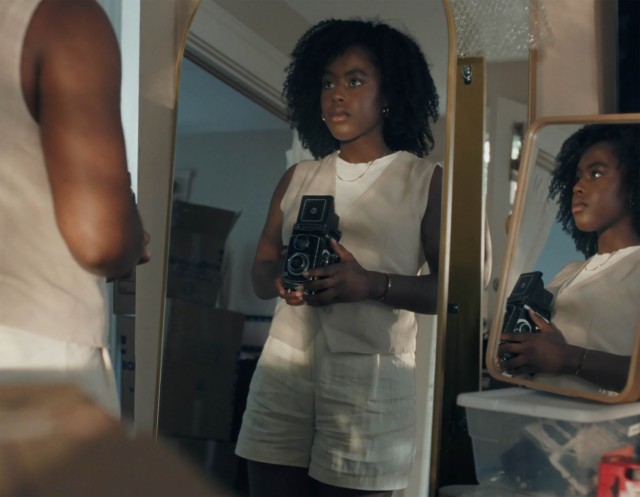
Doyin Domingo stars as Rene in J.D. Shields’ Blue Hour
Soon enough, we come to see Rene as an independent professional, split several ways (as that mirror shot suggested) as she explores different avenues of income. She attempts to sell her vintage camera (unsuccessfully), receives a rider request (which she declines), and then heads off to a photoshoot. As a freelancer myself, I felt deeply connected to Rene.
The photoshoot serves as the climax of the short and where its message truly comes to fruition. Rene is unknowingly hired for a bereavement photoshoot of a mother, Jaz, and her son. The vehicle of photography creates a space that is simultaneously distant, empathetic, and intimate. While neither Rene nor the viewer knows the full details or exactly what Jaz is feeling, a connection is fostered through the act of capturing the moment. Shields explains that the use of photography and strangers was intentional, shaping how the story is perceived. Explaining that her hope is “that the work resonates with viewers whether or not they have been through something thematically, emotionally, or narratively similar.” Shields succeeds in this hope, using photography as a throughline to connect the viewer to Rene.
We’re excited to champion such an important and beautifully made film on Short of the Week. Shields’ creative team is “over 80% women/non-binary, BIPOC, and/or LGBTQIA+,” which we applaud, and we can’t wait to see more from them! While the story of Blue Hour is undoubtedly heavy, it is told in such a moving and thoughtful way that it rightfully lingers in the mind in all the best ways.