
 Rob Munday
There is something profoundly sobering about witnessing an accident in real life. I attended the Bournemouth Air Festival in 2021, where a biplane – with a wing-walker positioned on top – crashed into the sea. Although I was not close enough to observe the precise moment of impact, the force of the crash was nonetheless palpable, reverberating through the assembled crowd.
While Max Henderson’s SXSW documentary, The Goldfish Club – a title derived from the term used to describe individuals who have survived aircraft crashes into water – orbits this incident, it is not the film’s primary focus. Instead, the crash functions as a narrative anchor for a broader exploration of friendship, love, and trust, offering a fly-on-the-wall perspective on the extraordinary bond between the pilot and the wing-walkers.
“I went out to England to shoot something that I thought was visually mesmerizing and to just make a vibey edit”
With wing-walking such an inherently spectacular viewing experience, it comes as no surprise that director Henderson initially envisioned the film as something “visually mesmerizing,” edited into what he describes as a “vibey” montage of individuals strapped to the tops of aircraft. However, after spending time with pilot David Barrell and wing-walkers Kirsten Pobjoy and Emma Broadbent, and witnessing the depth of their connection in the aftermath of the accident, he recognised that this human bond was “more important to document than what was going on in the air.”
In an effort to remain as unobtrusive as possible, Henderson quickly observed that placing the trio of Barrell, Pobjoy and Broadbent directly in front of the camera initially altered their behaviour, prompting them to self-edit both their actions and speech. In response, the director adopted a more observational approach: he began arriving at the airfield without ceremony, fitting the trio with lavalier microphones at the start of each day and remaining prepared to film whenever moments of significance emerged.
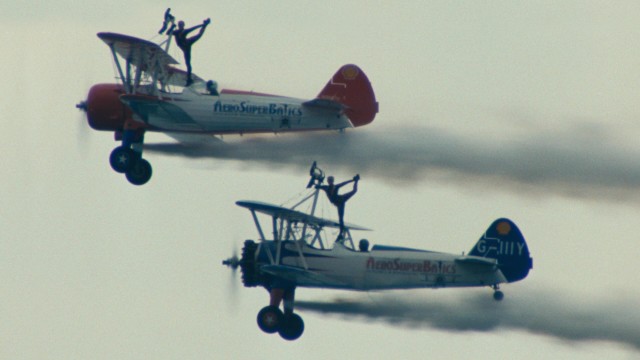
“The camera I shot this on is an Aaton XTR Prod, which is one of the most silent film cameras available” – Henderson discussing his production.
Henderson notes that it took “about two weeks for them to finally start ignoring the camera,” after which he became, in effect, a fly on the wall in their daily routines, admitting that “for the most part I was completely ignored.” This discreet presence granted him access to their “unfiltered interactions,” revealing the depth of their connection and the emotional significance in one another’s lives more effectively than any conventional interview format could convey.
In this way, The Goldfish Club operates as a hybrid of two established documentary formats: the portrait documentary and the observational documentary. Like the portrait form, it offers intimate insight into the lives of individuals driven by an uncommon and highly specialised pursuit. However, by incorporating the measured pacing and attentiveness of observational filmmaking, the film achieves a tone that feels authentic, unforced, and deeply affecting. It is a testament to Henderson’s direction that, despite the short film’s striking visual premise, it is ultimately the people at the centre of the narrative who leave the most lasting impression.