
 Jason Sondhi
Pinscreen animation is having a moment, and we’re over the moon. Pierre-Luc Granjon’s delightful fairytale, The Night Boots, utilizes nearly 100-year-old filmmaking technology and has subsequently been honored with the Cristal at Annecy while landing a spot on the shortlist for Oscar. Success like this will inspire imitators, and for pinscreen—which as recently as a decade ago looked as though it could be lost to history—that means a new generation of practitioners to keep its traditions alive.
The pinscreen is a device that animates via shadow. You push pins out from a board and shine light down from an angle—the arrangement and depth of the pins create shadows of differing length, allowing for gradation and resulting in a soft-edged image that has something of the quality of a charcoal sketch. Developed by husband and wife Alexandre Alexeieff and Claire Parkerin the 1930s and used to produce the 1933 masterpiece, Night on Bald Mountain, the seamless collaboration of the pair was thought to be inimitable, so the technique barely survived its inventors. The National Film Board of Canada had purchased a pinscreen at some point, though, and Jacques Drouin picked up the form’s baton in the 1960s. It was through Drouin that I first learned of the technique almost 20 years ago, via a series of educational modules hosted on the NFB’s website, and subsequently selected his masterpiece, Mindscape, as a featured pick during Short of the Week’s first year of existence.
For those curious about this history, Animation Obsessive published a great piece back in October that I recommend. Drouin’s revival of the form was picked up by Michèle Lemieux, who led masterclasses in France on a restored Alexeieff-Parker board. Justine Vuylsteker produced a recent S/W pick via this board, and Lemieux’s latest was at Annecy in 2024. Granjon and The Night Boots are next in this lineage.
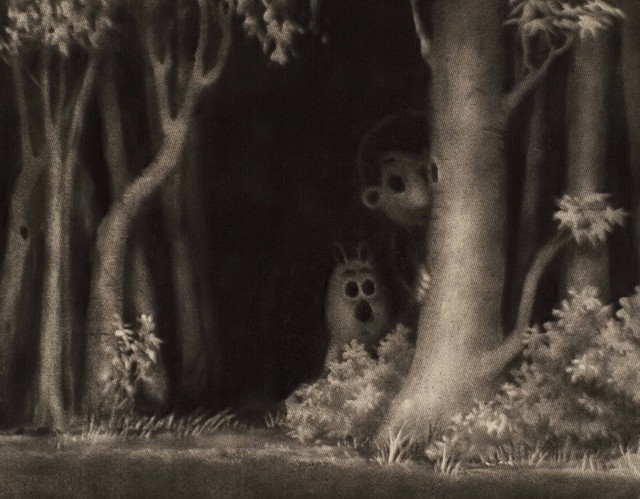
Elliot and the monster.
While the rarity of the pinscreen is a natural hook into The Night Boots, I feel sheepish to once again lead our coverage of a shortlisted animation with a discussion on how the film was made, rather than what has been made. As detailed above, pinscreen short films, while still infrequent, have been steadily produced during the last few years, so this short’s acclaim cannot be chalked up to novelty. Instead, Granjon has produced a delightfully open-hearted fairytale of a boy and a monster, that, in the best of fairytale ways, skirts darkness and what is scary in the night, but ultimately provides an invaluable lesson for how to live. It’s a film perfect for children, but no less affecting for adults.
After a night with his family entertaining guests at a house in the woods, a young boy named Elliott heads off to bed. Stray dialogue establishes that Elliott is a lonely boy, attending a new school, and without friends as of yet. An acorn dropping through his window entices him to sneak off into the forest, where, perched in a tree overlooking a pristine lake, a strange talking creature addresses him.
The creature’s innocuous looks do not mean that it is without menace, and there is a tension at this point in the film. Is this cute figure, in fact, a malignant trickster? Its firm insistence when ordering the boy around raises concern. What about its talk about the “monster of the lake”? Is it luring Elliot to a tragic fate? Yet, it is only a minor spoiler to inform you that the creature does not pose a threat to Elliot. He is, instead, a creature without guile, and it is only the reflection of our own predisposition toward fear that colors him as such. Granjon expands upon this idea with us, relating over email that, with the character, he sought to depict the type of person who is “devoid of shyness, who comes up to you and speaks as if they already know you.” The creature does not follow the formalities of meeting someone new, but Elliot learns to go with it, venturing outside his comfort zone to have a magical experience and make a new friend.
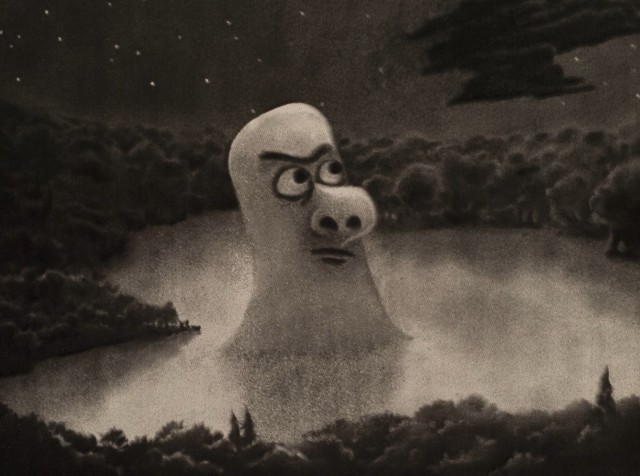
The monster of the lake
For Granjon, The Night Boots is a fable about not being reactionary to that which is foreign or strange. The increasing tribalism and scapegoating of contemporary life certainly make this a timely moral lesson. The pinscreen technique also plays into this sensibility, allowing for subtle morphing and transitions that turn the familiar unfamiliar, and back again. The edge between fantasy and reality is subtle, but fluid within the film, and Granjon especially credits the high-contrast but soft shadows of the technique with his ability to depict the moonlit forest setting of the film without resulting in an image that was exceedingly dark and gloomy.
Granjon, alongside the production company AM STRAM GRAM, the film’s distributors Pentacle, and in collaboration with The Animation Showcase, has reached out to us to offer a limited online availability for the film in advance of the Oscar nomination vote this month. Viewers will have till the end of January to watch via this site, Shortverse, or YouTube. We hope you take advantage of this window to enjoy one of 2025’s most pure and magical short films.