
 Mariana Rekka
We are social creatures by nature. We learn who we are – and what we want – mostly by comparing and sharing ourselves to others. It is through being seen in this way that social connection becomes essential to the development of empathy and self-esteem. But what happens when that skill is prohibited? What happens when isolation becomes punishment, and emotional numbness the cost of survival?
Nathan Fagan’s short documentary Inside, The Valley Sings explores that question by immersing viewers in the inner lives of three prisoners subjected to solitary confinement in the United States. Trapped in 6×9-foot cells for weeks, years, or even decades, they describe an existence stripped of human contact, time, and sensory grounding. How would you cope?
The film doesn’t waste time on the prisoners’ crimes or on questions of culpability; instead, it examines the justification for this kind of isolation, and its consequences. Rather than focusing solely on the physical horrors, Fagan’s film turns inward. Through audio interviews with survivors Kiana Calloway, Frank De Palma, and Sunny Jacobs, we hear how the boundary between reality and imagination begins to dissolve under prolonged solitude. To survive, they describe constructing elaborate inner worlds – places filled with the textures, colors, and experiences denied to them inside their cells, accessible only through their minds. These imagined landscapes are not mere escapes; they are lifelines. As De Palma explains, they became “as real to me as your life is to you.”
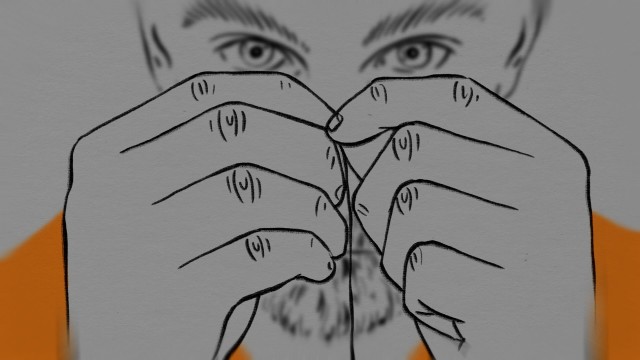
“My goal with this film was simple: to give a voice to this largely voiceless population” – Fagan discussing the aims of his short
The animation mirrors this fragile mental state through hand-drawn imagery and rotoscoped movement, blurring the edges between fantasy and memory, confinement and freedom. While the prisoners’ lived realities are rotoscoped to echo actual movement, their imaginations flow freely – almost like liquid – where figures stretch, dissolve, and reform, distinct to each of the three voices. Spaces open where none exist, allowing moments of escape from the daily grind and a way to cling to sanity. Yet the visuals never overwhelm the testimonies; they listen to them, translating words into sensations. What emerges is something quietly devastating: proof that even when the body is confined, the mind will always search for air.
Fagan’s intention is clear and measured: to give voice to a population rarely heard and to reveal solitary confinement for what it is – a form of torture, plain and simple. The film does not make this argument loudly, because it does not need to. By allowing survivors to speak for themselves, the conclusion becomes unavoidable, as Fagan allows us to sit inside the mental landscapes the protagonists built in order to survive.
Inside, The Valley Sings is a sobering reminder that no justice system can claim to uphold dignity while erasing human connection. How can we expect to reintegrate people into society after denying them the very social fabric that makes us human? Regardless of guilt or innocence, the need for contact, imagination, and hope is universal; to deny it is not punishment – it is erasure.