
 Rob Munday
Described by its creator as an “elegy for the men who died too young,” Kerli Kirch Schneider’s enigmatic film Virago transports audiences to a European village where men don’t survive beyond the age of forty. Offering a poetic examination of gender roles, the short film blends mythology with social commentary to construct a darkly humorous fairytale that ultimately serves as a “tribute to the women who endured.”
With the film’s exposition centred on the origin of the village’s curse – when the men chose to hide in the woods at the outbreak of war – the remainder of the short follows Tõnu, the oldest man in the community, as he approaches his fortieth birthday. As the audience witnesses the inventive deaths of Virago’s other men, questions arise as to how Tõnu has survived for so long and what his continued existence signifies for his wife, who appears determined to protect him despite her assertion that he is a “sh*tty man.”
“In that community, men often died young”
“The idea of a village cursed by its own gender myth resonated deeply with me – both as a reflection of lived experience and as a symbolic exploration of how social structures can solidify into fate,” Schneider explains, as she reflects on how the Estonian village in which she grew up informed the development of the film’s narrative. “In that community, men often died young, leaving women to shoulder what is commonly described as the ‘triple burden’ – wage labour, domestic work, and emotional caregiving,” she adds.
Schneider notes that through Virago she sought to “examine the intersection of folklore and gender,” with particular attention to the moment at which “myth becomes a mirror for the endurance and survival that define everyday life.” The short ultimately became a means of processing personal memory through cinema, blending “social critique with mythic structure” to transform the “trauma of rural, gendered existence into allegory”.
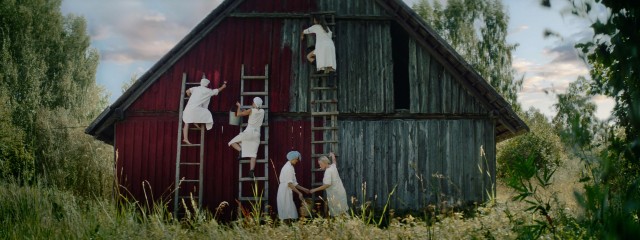
“Virago became a space where I could fuse personal memory with social critique and mythic structure — transforming the trauma of rural gendered existence into allegory” – Scheider discussing her aims for the film
Given the personal nature of Virago, it was clearly important for Schneider to cast a significant number of South Estonian locals in the film. Despite the short’s fairytale-like qualities, the narrative would have felt uncannily familiar to many of the performers, as Schneider notes that “their lived experiences closely mirror the realities portrayed in the film.” This approach not only added a much-needed layer of authenticity to the story, but also fostered a strong sense of collective belonging among those involved.
“For months – and even years after – the film became the talk of the town, a shared reflection of collective memory and identity,” Schneider explains. “With many members of the creative team also hailing from South Estonia, the process evolved into something that felt deeply participatory – a true collaboration between filmmakers and the community that shaped them. It was, in every sense, an unforgettable and profoundly human experience.”