
 Jason Sondhi
There are works of art where the estimation of their overall quality by critics and audiences alike takes a backseat to the narrative of their development. Think of films like Russian Ark, famous for being a feature-length oner, or the novel casting of Richard Linklater’s Boyhood. Stop-motion, with its meticulous slowness and the romanticism of its isolated, craftsman aesthetic, is attractive to this impulse, and Playing God is deserving of being discussed in this manner—seven years in the making, it possesses a mixture of puppet, clay, and pixilation animation, with over 60 models in motion, detailed with elements like real tears and saliva. Days would pass where only a handful of frames were completed. It has been a masochistic enterprise that writer/director Matteo Burani and his Studio Croma partner, Animator/Producer Arianna Gheller, have set forth for themselves, and much of the publicity for the short, following its selection to the Oscar shortlist last week, has circled this Herculean effort.
Burani and Gheller have encouraged this angle as well, as seen in their recently released BTS film which is dominated by discussion of the difficulty of the undertaking. Yet, it would be a shame in my mind if the discourse surrounding Playing God became dominated by its creators’ endurance. The loving detail of its craft is indeed the first thing one notices in the film, but, now that it is online for a special 1-month limited run in advance of the Oscar nomination vote, many will discover other exceptional aspects to the work—a fragile optimism in theme, grace notes of dark comedy in the plot, and a tasteful suite of stylistic references that reflect its inherited Italian tradition.
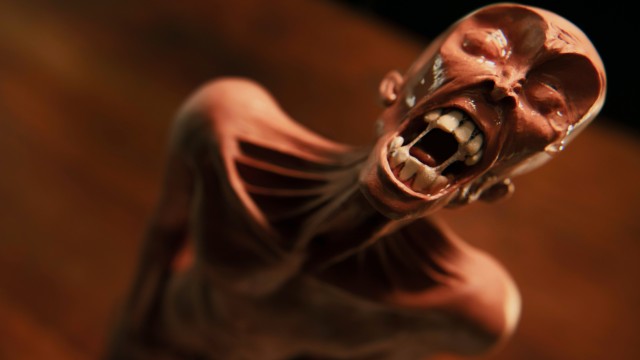
The film’s creators cite Caravaggio and Goya as influences on the film’s lighting and “figurative intensity”
Playing God follows the birth of a creation. A metal frame, highlighted in the center of a workman’s bench, is the starting point. We see clay being slapped together into “living flesh” as a male puppet takes shape. The details of this creation are probably the most satisfying sequence of the film—the morphing transformation of lumps into shape is elegant and exciting to behold, while the rapidity of the process, its supernatural pace, evokes the divine. The Sculptor is mainly two hands at work, though sometimes the scribble of a pencil, or the measurement of a ruler. He is distant and unknowable, though a single grasp of the thumb by his creation suggests this sculpture wishes otherwise.
To the side of the creation is a menagerie of similar models, yet they are horribly disfigured. Their uncomfortable presence drives much of the tension of the film. Is the Sculptor sadistic? Do the figures feel pain? Why have they been abandoned? What will happen to our (relatively normal-looking) sculpture?
I initially saw a darkly cruel film, one of parental abandonment, mythic self-fulfilling prophecy, and wretched fate. So, it was a surprise when, in discussion with Burani, I realized that he views his work as optimistic. Written alongside Gianmarco Valentino, the director proclaims that Playing God is a treatise on “what happens to creations once they are judged, rejected, or abandoned,” and seeks to present a shift from the creator/creature binary toward the community that surrounds it. The gallery of the disfigured is not the graveyard of the wretched, but instead a potential “source of strength” as a proto-community forged through rejection.
It is a lovely vision that is supported by the film. Yet, while Burani has intentions, his vision doesn’t have to be your interpretation. Fortunately, the film’s pleasures: its emotional urgency, its darkly funny visual punchlines, and, of course, the lovely and exquisite care extended to the animation, exceed its theme in primacy. As a piece of craft and visceral viewing experience, I think the film has a chance to be looked back upon as a classic, so, after winning dozens of festival awards, including “Best Animated Short” at Tribeca and the Jury Award at Animayo, this online release—co-presented via Autour de Minuit’s Animatic YouTube channel—will be the first test of that proposition. Watch and leave a comment, let us know what you think!