
 Rob Munday
In July 1518, Strasbourg was overtaken by a so-called “dancing plague,” during which hundreds of residents reportedly danced uncontrollably for days or even weeks, some to the point of collapse or death. This extraordinary historical episode – evidence that lived reality can often outstrip even the most imaginative fiction – serves as the foundation for filmmaker Hector Prats’ (Enloquecer) short film Heaven is Nobody’s. Drawing on his longstanding fascination with the events that unfolded in the French city, Prats reinterprets the phenomenon through a haunting, nightmarish lens, transforming this bygone mystery into a distinct, contemporary cinematic vision.
Prats’ 12-minute short opens with its protagonist, Narciso, emerging from a dream – a fitting entry point for a film the director characterises as taking place in “a world that only exists in our nightmares.” Although the stark black-and-white cinematography initially commands attention, it is the film’s audial architecture that generates its most compelling tension. “I wanted to create a hyper-sensorial soundscape and somber atmosphere that chased and trapped us,” Prats notes. Driven by a resonant techno beat that pulses beneath the imagery, the score becomes both an expressive voice and an ominous presence, guiding viewers through a dystopian landscape and ensnaring them, alongside Narciso, within its unfolding terrors.
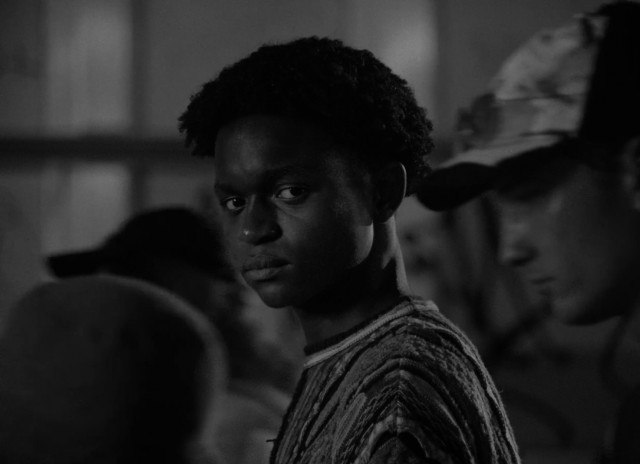
Jaylen Stapleton stars as Narsico in Heaven is Nobody’s
The world of Heaven is Nobody’s is not immediately alien, and it is precisely this proximity to the recognisable that renders the film so unsettling; the most disturbing dystopias, after all, are those that feel only a step removed from our own reality. Here, the black-and-white cinematography – often employed as a stylistic flourish – functions instead to intensify the film’s pervasive sense of foreboding without severing its ties to the everyday. The production design, locations and costumes operate in a similar register, reinforcing an atmosphere of eerie familiarity that blurs the boundary between the viewer’s world and the nightmare realm the film conjures.
“By all accounts this film shouldn’t exist”
For a film centred on a dancing curse, it seems fitting – if not eerily so – that the production of Heaven is Nobody’s was beset by its own series of misfortunes. “By all accounts this film shouldn’t exist,” producer Heather Francis (Sunshine City) reflects. The team lost two cinematographers due to COVID-related travel restrictions and a third to a car accident – resulting in a broken femur (from which they have since recovered). Under such circumstances, Francis’s description of the shoot as “close to impossible” hardly feels like an overstatement.
Yet Prats, along with his producer, cast, and crew, persisted. Despite repeated delays and rescheduling, their commitment to the project’s distinctive vision is palpable in the finished film. Heaven is Nobody’s may have been arduous to create, but it’s an absolute pleasure to watch – emerging as a striking and engaging viewing experience. With the writer-director now developing a feature-length project set within the same conceptual universe, audiences may soon find themselves returning to Prats’ haunting reimagining of the dancing plague.