
 Georg Csarmann
There is a Zen-like quality to a sentiment voiced early in My Neighbors Yard by one of Harrisburg, Pennsylvania’s residents: “Good neighbors don’t have to think alike.” You can’t choose who lives next door, and you certainly can’t control the signs they put in their front yard. In our overly politicized times, tolerating opposing views – and trying to understand the people behind them – is no easy task. But that’s exactly what Kara Grace Miller’s serene documentary tries to achieve.
At the center of the documentary are Ed and Karen Snell, an elderly couple who have been placing pro-life and other conservative religious signs in their front yard for decades, with a recent focus on MAGA messaging. What makes My Neighbor’s Yard – and Miller’s approach – so compelling is the contrast between their aggressive pictorial rhetoric and their mild-mannered, unassuming interviews. A similar dissonance applies to another neighbor, who staged a reenactment of the assassination attempt on Donald Trump in his yard, complete with skeletons representing both the shooter on the roof and the injured (at the time) presidential candidate.
“I borrowed a camera, drove to my parents home, and found a way into the election conversation through a fixation I had formed while on the road; yard signs.”
These interviews, featuring voices from both sides of the political spectrum, are interwoven with footage from the election trail and emblematic snapshots of Harrisburg’s charged political atmosphere. Miller’s evenhanded storytelling is even more impressive considering the director’s background and the fact that this is her first documentary. Drawing on lessons learned from 18-months of producing voter testimonials for congressional and presidential races, she explains: “I’d seen the most divided, loud, and targeted regions of the country through arenas and family dinner tables.”
That experience motivated her to find a way to combine her personal and professional insights, particularly in relation to her hometown of Harrisburg. “After leaving the campaign trail in early October, it felt incomplete to stop documenting the election process then. I borrowed a camera, drove to my parents home, and found a way into the election conversation through a fixation I had formed while on the road; yard signs.”
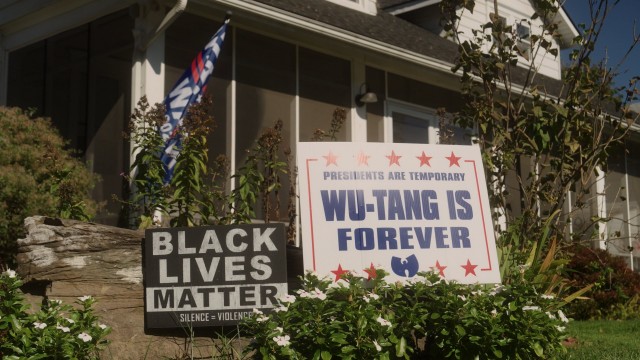
“As the political chasm deepens rapidly nationwide, I feel Central Pennsylvania is a political microcosm of the country as a whole” – Miller discussing shooting her documentary in Harrisburg
To be honest, watching My Neighbor’s Yard can be irritating – even infuriating at times – but that’s not a flaw of the film itself. Miller worked with editor Rory Stevenson to craft an even-handed portrayal, which provides a kind of Rorschach test to one’s own political views and mindset. She doesn’t judge her interviewees, instead presenting multiple perspectives on a contentious topic and leaving it up to the audience to form their own opinions. Miller’s calm direction doesn’t push a specific, obvious agenda. If you are on Ed and Karen’s side, then My Neighbors Yard is an almost sweet-natured depiction of their convictions. If not, it can be hard to fathom what you are seeing.
Either way, learning more about the making of the film helps to understand how Miller managed to establish such a sensible connection to the couple at its core. As she told S/W, she had somewhat of a personal link to Ed and Karen. “My earliest childhood memory of [one of their] billboard-like sign[s] was a gruesome photo of what I now understand to be a late stage, stillborn fetus. I’d pass their new signs every week after that, the graphic abortion imagery slowly growing into far-right political ideology tying a party, and then a singular presidential candidate, to their pro-life cause. After two decades of wondering why, I finally knocked on their door.”
As the old saying goes, there are three things you don’t talk about: politics, religion and money – but today, it seems the opposite is true. Displaying political signs or religious statements in your yard isn’t keeping quiet; it’s broadcasting opinions for all to see. However, in our social-media-saturated world, aren’t yard signs just the analog version of a political bio on X or a meme on Facebook? If so, then Ed Snell was a political influencer before there was an internet.
“The day after the election, we expected some sort of public demonstration”
As Ezra Klein points out in his formidable book Why We’re Polarized, this tribalistic display of opinions probably has more in common with sports rivalries than civic debate. Yet, after the election, the signs came down and life went on. “We expected some sort of public demonstration,” Miller explains as she discusses the aftermath of the election. However, the lack of such a reaction led the director to the “true, understated, continuous ending” of My Neighbor’s Yard and not the “explosive, final climax we were naively planning on.”
It is somehow strange to write about a film like My Neighbor’s Yard as someone who doesn’t have immediate skin in the game. Yet, as Ed Snell says at the end of the film, “How America goes, the world goes.“ Perhaps being someone on the outside looking in has its own advantage. I don’t live in the United States, but I’ve followed US politics more closely over the last decade than any news in Europe. I am much more interested in American history, culture, and socioeconomic developments, than anything that is happening anywhere else. Still, I’ve come to accept that certain aspects of the American experience will always remain foreign to me, in more ways than one.
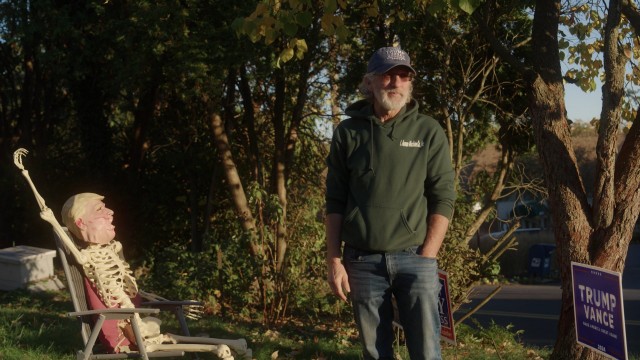
“The film was not meant to show that one side was right or wrong, but that all of these neighbors, regardless of party, were attempting to have the same influence” – Miller on the aim of her short
The practice of turning one’s yard into an advertisement of political allegiance – complete with large, explicit signs and Halloween-style reenactments of assassination attempts – is beyond my personal frame of reference. However, My Neighbor’s Yard offers a perspective to help understand the circumstances of this peculiar phenomenon and provide valuable insight for both news-junkies and those encountering this side of US politics for the first time
Tackling polarized politics is no small feat – for a filmmaker or a critic. Watching My Neighbor’s Yard proved an unnerving experience at times, but forcing too much of my own personal opinion into this article wouldn’t reflect the short’s aim of impartiality. What interest me now are the potential reactions to the film or this review. It will be interesting if commenters will try to be as objective as possible in the spirit of My Neighbor’s Yard’s approach – the reaction to the film may well become its own commentary on the state of discourse today.