
 Rob Munday
As a programmer, there are films you see and immediately know you want for your platform/event – Renaldho Pelle’s The Fire Next Time wasn’t one of them. When I first encountered it as a work-in-progress at the NFTS grad show in 2019, it struck me as intriguing, but I couldn’t yet see the full potential. Fast forward a couple of years to Sundance 2021, and I was stunned by the transformation. What I saw was one of the most exciting and original pieces of animation to emerge from the school – an institution already renowned for dominating the UK awards scene – in quite some time.
“For me rioting is an expression of people’s power and agency over the spaces they inhabit”
The Fire Next Time unfolds on a London estate as a shadowy oppression begins to creep in. It opens quietly, with muted conversations, small conflicts, and the uneasy sense of something closing in. But the tone shifts dramatically when police unnecessarily confront three friends on the streets. As the percussive soundtrack gathers momentum, the film surges into an atmosphere of social unrest and riot.
Created in response to the 2011 London Riots – an event he feels has been “neglected or worse, deliberately diminished” – Pelle’s short stands as a manifestation of his anger toward an unjust society. “For me rioting is an expression of people’s power and agency over the spaces they inhabit,” the filmmaker explains. Like many others after the riots, he felt deeply frustrated — angry at “those who enforce the law [and] are willing to use force and sometimes even take lives on suspicion of some minor offence,” and at “those who would justify those actions.”
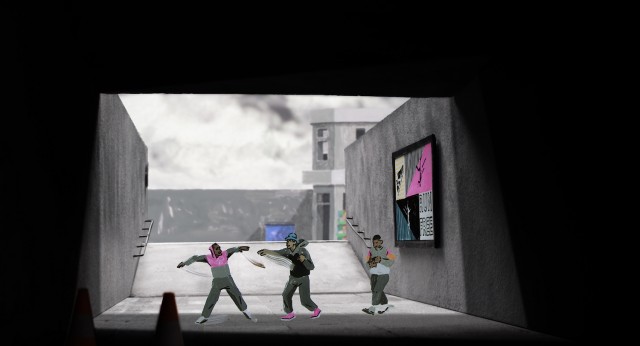
The Fire Next Time combines paint on glass animation with ‘brutalist inspired’ stop-motion sets and projection.
That anger is palpable on screen. The Fire Next Time feels like a simmering pot, always on the verge of boiling over. The shadowy, unexplained oppression closing in on the estate becomes a perfect metaphor for the way society continues to treat those of lower socio-economic status. While, the introduction of the djembe drum soundtrack shifts the audience from detached spectators to active participants.
Created to “encourage people to feel compassion for the problems of others … and help them begin to think about how they might bring about change,” The Fire Next Time may have been born from events 14 years ago, but it remains just as powerful and relevant today. With that in mind, it feels only right to leave the final word to Pelle, as his own are more vital than anything I could add:
“I feel scared because I myself and most of those whom I love are part of that group that mean so little to society. I feel angry at how difficult it is for those of us from poor backgrounds to share the benefits of our society. At how hard we have to fight to follow the ‘right’ path, and how easily we are condemned when we do not. Angry at feeling outside of the society I have been born into. I am sure I am not alone in feeling this way, and that is why I made The Fire Next Time.”