
 Rob Munday
History has long provided fertile ground for filmmakers, with feature directors often drawing on iconic figures and pivotal events to shape their stories. In the world of short film, however, where resources are tighter, filmmakers must find more inventive ways to harness the past. Director Natalie Cubides-Brady does just that with The Veiled City, skilfully repurposing footage from London’s Great Smog of 1952 to craft a haunting fusion of documentary and fiction that resonates as a commentary on today’s climate crisis.
“Living through climate breakdown involves living in two tenses at the same time”
The story of a time traveller sent 250 years into the past, The Veiled City employs archival footage and a voice-over diary to chart the explorer’s search for the origins of a catastrophe devastating the world in 2198. Journeying through the smog-covered streets of London, the blackened corridors of coal mines and the stark interiors of laboratories, the narrator conjures a vision of a future where skies blacken and toxic clouds descend – urging us, the audience, to reflect on our own future in a world battling against pollution.
“Living through climate breakdown involves living in two tenses at the same time”, Cubides-Brady explains as we discuss the aims of her film. “You find yourself thinking about the future while living in the present, projecting forward and back from the everyday.” This tension is what she set out to capture in The Veiled City, prompting audiences to confront the state of our environment while imagining what lies ahead.
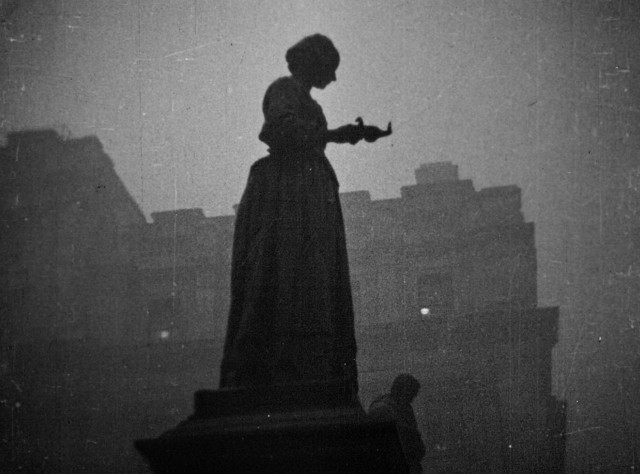
“I immediately knew that I wanted to make a film that responded to this event” – Cubides-Brady discussing how photos of the Great Smog inspired her film.
From the moment Cubides-Brady came across photographs of London during the Great Smog, she immediately knew she wanted to craft a film around them. At first, she was captivated by their beauty; only later did she fully grasp the horror they depicted. “They were photographs of an environmental disaster”, she recalls. “The images were paradoxical – the city looked like a dreamlike landscape but also a site of death. They looked like they belonged in a science-fiction story.”
That final realisation was key in shaping The Veiled City. By approaching the images as glimpses of future catastrophe, Cubides-Brady began weaving a speculative timeline – blurring past, present, and future. Composed entirely of archival footage, the film took shape visually before she wrote the voiceover, allowing the imagery to dictate its rhythm and tone. The result is one of the most haunting shorts in recent memory: a hybrid of documentary technique and science-fiction narrative that echoes Jake Hinkson’s words on La Jetée (surely an inspiration for this film?) – that “a person cannot escape their own time… we will always be dragged back into the world, into the here and now.” A sentiment that resonates profoundly within The Veiled City.