
 Jason Sondhi
A Wild Kindness is a short film well-fitted to its Pacific Northwest setting, and by extension, appeals to me, who spent a decade in the region. It is earnest, but slightly quirky; naturally beautiful, but not without artifice or self-consciousness. More than anything, it is, befitting its title, very sweet. And if the short fails to be a revelation to you over its 23min runtime, I believe you will still applaud the audacity to tell a fairly common profile doc story that is elevated and sustained entirely by affection and filmmaking guile.
The film is from Mattias Evangelista, who previously featured on Short of the Week for There’s No End, a contemplative doc on Washington State indie-music legend Phil Elvrum. That short ditched the standard profile doc playbook for intense and vulnerable philosophizing with its subject, and while otherwise dissimilar, A Wild Kindness shares a bit of that impulse. The film centers on Al, who runs a very successful woodworking shop on the secluded Lummi Island, off the Washington state coast. The story serves as a disquisition into his craft, but also his long and loving relationship with his wife, Lindy. Evangelista has known Al and Lindy all his life, and treasures his close relationship with them. “As I got older and experienced my own parents’ separation, Al and Lindy’s relationship became even more meaningful in my eyes. I wanted to create a film that felt transcendent and beautiful and centered around some of the existential questions of human existence. I was also eager to explore hybrid documentary filmmaking, and I knew this would be a safe environment for creative experimentation.”
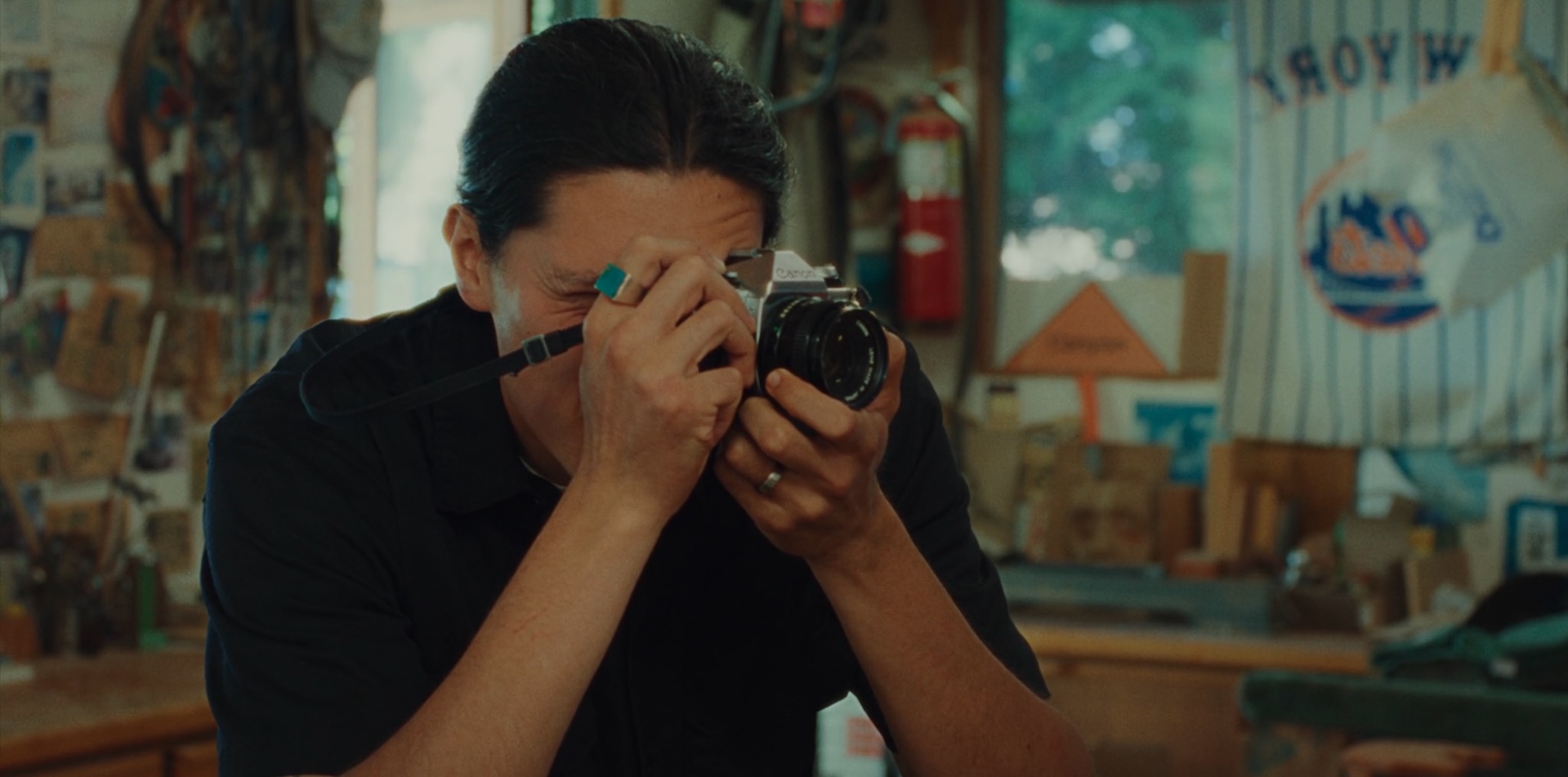
We meet Al and Lindy through the character of Michael.
That, at the end of Evangelista’s statement, is the key wrinkle in A Wild Kindness. Al and Lindy are good people who’ve crafted a great life, but don’t represent the typical “hook” that serves as a foundation for a profile doc. What Evangelista does is invite a separate character, played by Michael Wayne Smith, to serve as an audience stand-in and “discover” Al’s workshop, meeting Al and Lindy in an encounter that is unscripted, but outlined.
This sort of hybrid approach is not an innovation per se—we’ve been seeing more experimentation in documentary storytelling of late, perhaps corresponding to the medium’s commercial struggles—but it is still uncommon, and a strong fit for Evangelista and this story. If Al and Lindy’s exceptional lives lack a bit of the pizzazz we associate with the genre, then Michael’s character helps by decentering them slightly, buttressing the film with a tried and true coming-of-age storyline of a young man meeting a mentor, and allowing us into their lives more naturally, without the artifice of formal interviews. The active participation of the subjects in the storytelling is also a boon to Evangelista, who has a phenomenal photographic eye for the cinematic. A hybrid approach allows him, in combination with his DP, Christian Klein, the additional time to set up and maximize the impact of his compositions. As a filmmaker intuitively attuned to the transcendent, this combination of photography, story, craftsmanship, and natural beauty combining in homage to a life well-lived, creates a cumulative sensation of the sacred that, in contrast to my opening paragraph, is perhaps just revelatory.
A Wild Kindness came to us off a modest festival run that included Raindance and Brooklyn FF, and Evangelista is proud of the work, noting that “I already feel a sense of accomplishment with this film, simply because the process itself was so enjoyable, creating art with people I’m close to, in a place I love.” We love it too, but the risks in the premise of the film are apparent, and it might not have been possible without the participation of TRUST, the film fund that is within the Filmsupply/Musicbed family of companies, and which has, in its short time operating, executive-produced dozens of shorts. The freedom Trust provided to take risks on the hybrid style was a boon to Evangelista, who is now taken with the technique, saying that, “I truly believe this process cracked something open for me, and I see most of my future films being built around this approach.”