
 Georgina Kritikos
I wanted to die but immortality became my saving grace; this is the nucleus of A.K. Espada’s (This is Our Home) I Could Just Die, and That Would be Alright – a thrilling fusion of the supernatural and the subconscious. While genre films often carry psychological undertones for those willing to read between the lines, this film boldly places them front and center, creating a fresh and exhilarating dynamic to the horror short.
We meet our protagonist as she’s going for a night run – a ritual that helps her cope with mental challenges and hide suicidal thoughts from her husband. A dissonant, unsettling score accompanies her, tears streaking her face, until she eventually stops to face a deer in the middle of a pitch black road. The shot-reverse-shot between the woman and the animal feels like watching someone look at their own reflection, while in a state of desperation. Much like the deer, our protagonist feels helpless, trapped in a constant state of flight or fight.
She feels like a burden, sucking the soul out of her husband, and yet also doesn’t feel seen by him. Later, as she runs again, she encounters a deer crossing sign – the literal turning point of the film. This time, she takes a turn off the road and into the forest, ultimately deciding against being a deer and instead surrendering to the mysterious creature that lives among the trees.

A bloody encounter with a mysterious beast leaves the short’s protagonist a changed woman.
Following this bloody encounter, the protagonist becomes the literal embodiment of what she feared she already was: a “bloodsucker” or, as the films calls it, a “Bonecat”. Reflecting upon her inspiration for the story, writer/director Espada explains how mythology from her hometown in Georgia was influential: “The Bonecat is frightening, but also tragic – it’s just a sick animal that sustains and heals its wounds by harming others. I have a soft spot for misunderstood animals. I wanted to portray the Runner clawing her way out of despair as a deeply animalistic instinct.”
At the end of her transition, it’s hard to tell if anything has truly changed in the dynamic of the marriage – however, everything has changed for our protagonist. The symbolism of becoming an immortal lifesucker allows her to come out of hiding. This is no longer about coping mechanisms, but instead about embracing the monstrous parts of herself. In doing so, she feels empowered – in a kind of bittersweet and unabashed way.
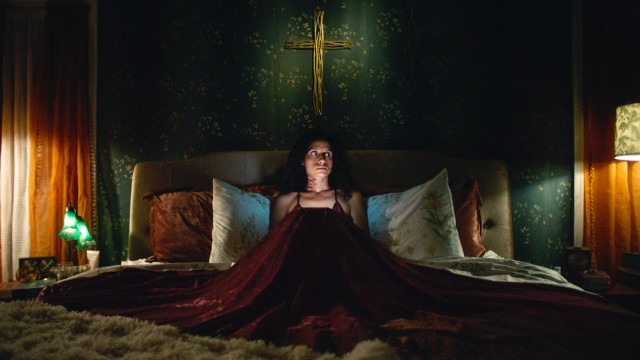
“We shot on the ARRI Alexa Mini with Zeiss Superspeed Mark IIs and Angenieux EZ Zooms (15-40mm and 30-90mm)” – Espada discussing production
I found the film’s structure particularly interesting. The use of timestamps stood out – they mark specific times and days, yet the narrative maintains a non-linearity quality. To me this felt intentional, mimicking some element of the protagonist’s dysregulated thinking patterns. Even as time moves forward, she continues to spiral back and forth, questioning if she is really a vampire or not. Ultimately, the day-to-day doesn’t necessarily matter so much – it’s the end result of her transformation that makes the impact.
And it’s that initial metamorphosis that contains my favorite part of the production. As she returns home, injured, bloody and now something different, the short takes a total shift of tone. The pacing becomes more relaxed, and eventually like the protagonist, I finally felt like I could breathe. The filmmaking choices – structure, tone, rhythm – play a crucial role in how the story is told here, and for that, I applaud everyone who had a hand in production.
“Audience members approached me after screenings to talk about how the film’s representation of suicidal ideation made them feel seen”
I Could Just Die, and That Would be Alright is a raw and challenging film, which tackles sensitive themes without falling into cliché or taboo. You don’t need to have personally struggled with depression or other emotional health challenges for the film to resonate. Through its focus on the unknown and its unapologetically blunt vulnerability, we allow ourselves into a (perhaps) new perspective with surprising ease. There is no tongue biting here (although there are some literal tongues with teeth!).
Personally, I actually found the film oddly comforting – relating to some of the themes and how they were presented. In our interview with Espada, she told us that her story took some inspiration from her own struggles. “Audience members approached me after screenings to talk about how the film’s representation of suicidal ideation made them feel seen,” she said. “They shared deeply personal things with me – a stranger – simply because I shared mine first”. This fact alone lends Espada’s short incredible emotional weight and we hope it can have a similar impact online.