
 Rob Munday
If modern Iranian cinema is renowned for its social commentary, realism, and restrained aesthetic, then Unjustified by Mohammad R. Khavari stands as a powerful embodiment of that tradition. Centred on a young pregnant student caught in a mounting crisis, the film offers a deeply grounded and emotionally resonant story. It not only captures the complexities of womanhood in contemporary Iranian society but also subtly explores the divides of class and culture.
“I wanted to provoke reflection and conversation around the invisible structures of control in seemingly democratic societies”
Set within a university, Unjustified follows its protagonist as she fights to be heard while others speak on her behalf. Drawing from his own experiences as a student, writer-director Khavari chose the academic setting as “a metaphor for society – a place where individual freedoms and institutional powers often clash.” He was particularly struck by how the university environment brought together “individuals from starkly different socioeconomic backgrounds”, and how this highlighted those aforementioned class and culture divides.
Aiming to “provoke reflection and conversation around the invisible structures of control in seemingly democratic societies,” Khavari’s film examines the shifting dynamics of power and their impact on personal freedom – particularly for women. “I hope the audience will question: Who gets to speak? Who is heard? And at what cost?” the filmmaker says. He adds, “if the film prompts viewers to recognize the subtle ways personal agency is stripped away – often under the guise of tradition or protection – then I believe it has fulfilled its purpose.”
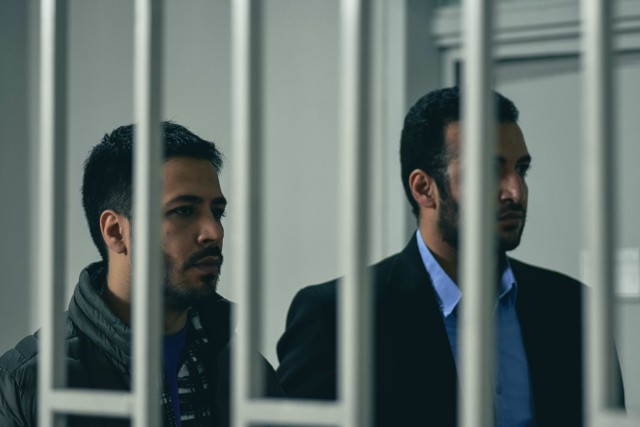
The location for Unjustified – an old school, once used as a prison – adds to the tension and atmosphere of the film.
With an understated aesthetic typical of Iranian cinema, Khavari knew that the success of Unjustified would depend heavily on casting and location – two elements he describes as “the backbone of a film.” For the setting, he chose an old, abandoned high school that had once served as a prison during the Iran-Iraq War in the 1980s and the industrial architecture of the space certainly heightens the film’s tension. “Many of its architectural scars still remained,” the director noted, adding that the stark contrast between “a place of punishment and one of learning” deeply resonated with the film’s core themes.
When it came to performances, Khavari dedicated nearly three months to working closely with his cast, ensuring they could fully embody the “psychological atmosphere” of the story. Though the shoot itself lasted only three days, the team returned to the location multiple times during pre-production – a process the director says was essential. “The emotional and visual foundations had been laid over months,” he explains. It’s this emotional depth, combined with the film’s social insight, that gives Unjustified its impact. While the filmmaking may not be formally groundbreaking, there’s a raw urgency to the storytelling that makes it impossible to ignore.