 Jason Sondhi
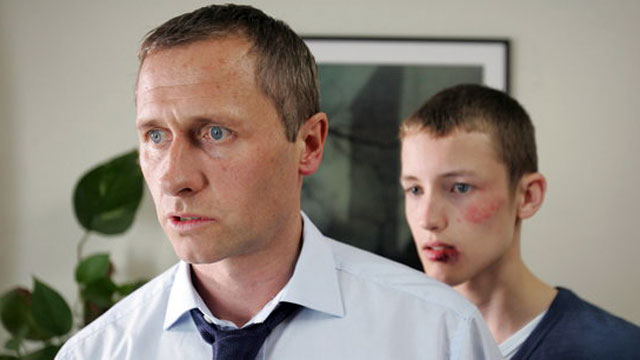
A simulated camcorder shot opens the film. Young thugs are on videoing spree, filming their exploits as they beat on an outnumbered youth. Cut to an overhead of a quiet suburban community. A man, the boy’s father, is coming home from work. He will soon have a confrontation with the thugs as well. Facing unprovoked and unreasonable violence, the father and son must choose individually to either stay themselves or to act—their already-rocky relationship and perceptions of each other dependent on what they choose.
This is the setup for Soft, a short film which is lean, yet inventive and diverse in technique—a true coming out for rising star British writer/director Simon Ellis. Shot on film over 5 days for the sum of 50,000 pounds, the short film is the product of a sponsorship by the UK Film Council and Film4 via their Cinema Extreme program, which identifies British film talent and supports their ability to step up to feature films by first tackling a professional short (edit 12/8/2010: R.I.P UK Film Council).
Based on the film’s reception, that decision to invest in Mr. Ellis seems wise. Soft was the recipient of the 2008 International Jury Prize at Sundance, as well as Best of the Fest at the ’07 Palm Springs Short Film Fest. What Soft accomplishes to garner such acclaim is multi-fold and seemingly contradictory: the short film is both novel and yet relatable, timeless in its themes yet extremely topical, and while so much of the film is about relationships and emotions, its defining moment is a thunderbolt of shocking action.
The reactions of the father and son to the violence initiated by the young hooligans is at the heart of the film’s allure, and it is a complex conflict. Simultaneously playing out on a physical as well as ethical level it defies easy resolution or second-guessing on the audience’s part. Moreover, the conflict is triangular—the man and son up against nameless aggression, but also the man and son versus each other, setting up a novel premise for the short film, that is yet still universal. After all, who has not confronted bullying?
“In my opinion, most short films are almost always too long but I felt this one needed room to breathe.”
Tension is masterfully manipulated through a slow burn pacing that pushes the film to its 13min runtime. In his 15 prior shorts Ellis had yet to break the 10min mark in length, and I generally agree with him in that doctrine. Yet in an interview, Ellis responds, “In my opinion, most short films are almost always too long but I felt this one needed room to breathe.” Soft benefits from that choice not only in atmospherics, but also in developing its characters.
The 13min runtime allows for a second stellar aspect of the film to shine through, which is its acting. The tension that is central to the film is largely generated from the performances—liberal employment of extreme facial close-ups that convey subtle notes of apprehension, dawning comprehension and resolve, which serve to move the film forward. It is rare that a short film so wholly relies on performance and character development as Soft does, but so much of the story is interior. It is truly the change and growth in its characters outlook and reactions which define the story, the explicit action is merely the consummation of information already conveyed.
Finally the film is topical, in a way that surely has benefited its reception in the UK. Having spent some time in London over the last few years, I can attest to a rising hysteria amongst media outlets and evidently the public at large, over the rise of “Hoodies”. Ellis definitely plays off of existing fears to great effect by imagining a villainous force of randomly violent, hip-hop inspired youth to serve as the catalyst for his story. Histories of Hoodie-hysteria often trace the rise of the phenomena to the controversial use of CCTV cameras on London’s streets and public places. The high angle shot which opens and closes the film is obviously meant to evoke this current reality of constant surveillance, and I imagine the Hoodie’s use of a camcorder in taping their sprees is in some way imagined as a rebellious rebuke of this policy as well. Yet while the Hoodies of the film are villains, thugs delighting in the delivering of abuse, I read a moral to the film that ultimately is dismissive of the threat of Hoodies—yes there exist bullies and maladjusted youngsters, but they are merely bullies, not a sinister new force. The real threat is the disconnect of a society from its youth. Elders chide and judge without understanding, while the youngsters scoff at their hypocrisy. This crisis is happening in the homes of communities, not on the streets.
Edit 12/08/2010: A new play link has been added, and some content of the article has been changed for clarity.